 Memorizing Quran
| Key Takeaways |
| Memorizing the entire Quran is achievable for non-Arabic speakers who follow a structured daily system with consistent Muraja’ah. |
| The Quran contains 604 pages and 30 Juz’; memorizing just 1 page daily completes the full text in under two years. |
| Adult non-Arabic speakers at Hifz Quran Online Academy typically reach stable retention of Juz Amma within 3–4 months of daily sessions. |
| Completing Hifz in one year requires memorizing approximately 1.7 pages daily with a disciplined revision ratio maintained throughout. |
| The forgetting curve begins within 24 hours; Muraja’ah must begin the day after new memorization to preserve long-term retention. |
Every week, students ask me some version of the same question: “Am I really capable of memorizing the whole Quran?” After years of teaching non-Arabic speakers across dozens of countries, my answer has never changed. Yes — it is absolutely possible, and it has been achieved by people far older, far busier, and far less confident than you feel right now.
What separates those who complete it from those who don’t is never ability — it is always method. The Quran’s 604 pages become manageable the moment a student stops treating memorization as an act of willpower and starts treating it as a structured, daily discipline built on correct technique.
Is It Possible to Memorize the Whole Quran?
Yes — memorizing the entire Quran is genuinely possible for any sincere Muslim, including non-Arabic speakers. The Quran contains 604 pages organized across 30 Juz’. At a consistent pace of one page per day, a student completes full memorization in approximately 604 days — roughly 20 months. Shorter timelines are achievable with a higher daily target and structured Muraja’ah.
Allah Himself guaranteed the Quran’s accessibility for remembrance. After your introductory paragraph, consider this reminder from the text itself:
وَلَقَدْ يَسَّرْنَا ٱلْقُرْءَانَ لِلذِّكْرِ فَهَلْ مِن مُّدَّكِرٍ
Wa laqad yassarnal-Qur’āna lidhdhikri fahal min muddakir
“And We have certainly made the Quran easy for remembrance, so is there any who will remember?” (Al-Qamar 54:17)
This verse is not rhetorical — it is a divine promise. What it does not mean, however, is that memorization requires no effort. It means the effort you apply will yield results when applied correctly.
The students I have watched struggle are not struggling because memorization is impossible. They are struggling because no one taught them a system.
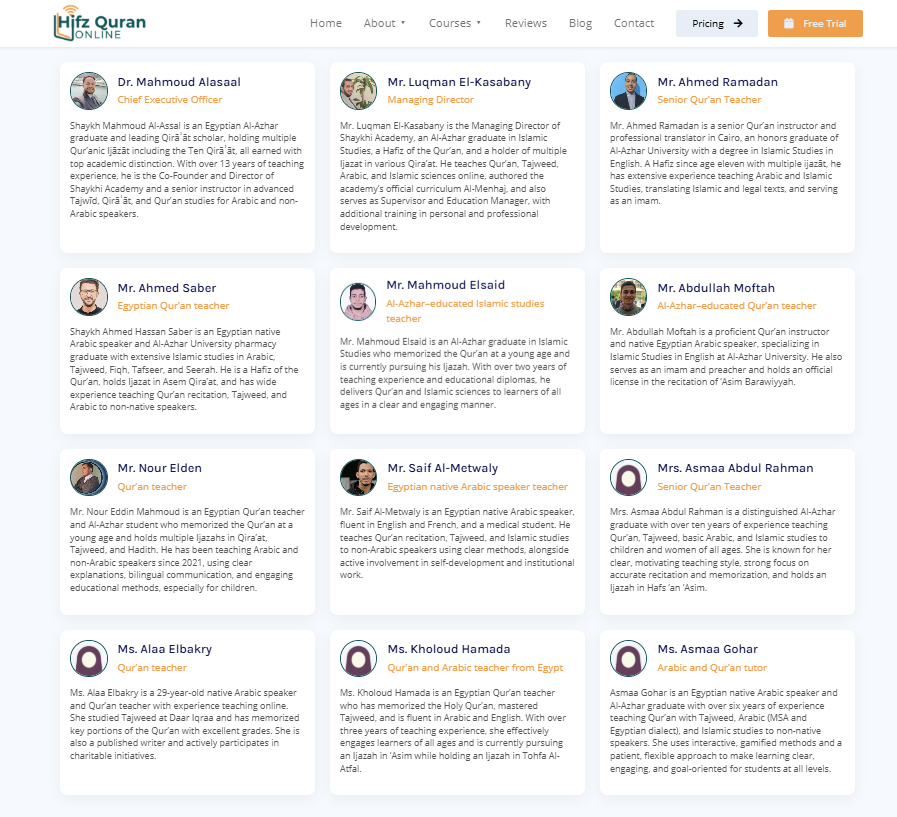
Students who enroll in the Quran Memorization Course at Hifz Quran Online Academy receive exactly that system — a structured, certified Hifz methodology built specifically for non-Arabic speakers, delivered by certified Huffaz in personalized one-on-one sessions.
Book a free trial to start your Hifz path today

How to Memorize the Whole Quran?
Memorizing the whole Quran requires a sequenced methodology — not motivation, not talent, and not a photographic memory. The steps below represent the foundational framework that certified Huffaz use with students at Hifz Quran Online Academy, refined through years of working specifically with non-native Arabic learners.
1. Establish Correct Tajweed Before Memorizing a Single Verse
Before beginning Hifz, every student must be able to recite with sound Tajweed. Memorizing incorrect pronunciation locks errors into long-term memory — errors that become exponentially harder to correct later.
At minimum, a student must have accurate Makhraj (articulation points) and understand the core rules of Ghunnah, Madd, and Waqf before beginning memorization.
If your Quran recitation is not yet fluent, the Al-Menhaj Book — a structured Quran reading program authored by Luqman ElKasabany and developed by instructors with 25+ years of experience — provides the ideal foundation before Hifz begins.
2. Choose a Single, Consistent Mushaf and Never Switch
Commit to one Quran edition from day one and never change it. The brain memorizes pages visually — the position of an ayah on the page, the line breaks, the spacing.
Switching between different Mushaf editions mid-Hifz causes genuine confusion, particularly when reciting from memory. The 15-line Madinah Mushaf (Hafs narration) is the standard used globally and is strongly recommended.
Memorize the Quran at Your Own Pace
Join our expert tutors and begin your Hifz journey with a personalized plan.
Start Your Free Trial3. Set a Realistic Daily New Memorization Target
A daily target of half a page to one full page is the sustainable standard for most adult non-Arabic learners. Attempting two or more pages daily without the revision infrastructure to support it leads to what instructors call “forward collapse” — new memorization that erases previous retention.
At Hifz Quran Online Academy, we advise beginners to start with half a page and increase only when revision is stable.
| Daily New Memorization | Estimated Completion Timeline |
| ½ page/day | ~3.3 years |
| 1 page/day | ~1.65 years (approx. 20 months) |
| 1.5 pages/day | ~13 months |
| 1.7 pages/day | ~12 months (1 year) |
| 2 pages/day | ~10 months |
4. Apply the Rabṭ Technique to Prevent Sequence Confusion
Rabṭ — the practice of linking the end of one verse to the opening of the next — is the single most underused technique in beginner Hifz. Before finalizing any new memorization session, recite the last two words of the previous ayah flowing directly into the first words of the new one.
This creates a neural bridge that prevents the most common mistake I observe in students: reciting each verse correctly in isolation but losing the thread when reciting sequentially.
Before introducing Rabṭ systematically at Hifz Quran Online Academy, students frequently stalled at verse transitions — especially in Surahs with similar rhythmic patterns like Al-Baqarah. After implementing Rabṭ as a daily closing practice, sequence errors dropped measurably within the first month.
Book a FREE session with one of our Ijazah-certified teachers
5. Memorize in Small, Repeated Units — Not Large Chunks
Divide each new page into 3–4 units of 2–3 lines and master each unit before moving to the next. Recite each unit a minimum of 20 times before attempting to connect it to the previous unit.
This repetition threshold is not arbitrary — it reflects how the brain consolidates phonetic information into retrievable long-term memory.
Students who attempt to memorize a full page in one sitting typically retain almost none of it by the following morning.
6. Prioritize Muraja’ah as Equally Important as New Memorization
Muraja’ah — systematic revision — is not secondary to new memorization. It is its equal counterpart. A student who memorizes 604 pages without sustained Muraja’ah has built a structure without a foundation.
The standard revision ratio recommended for adult learners is: for every 1 new page memorized, revise a minimum of 5 previously memorized pages. This ratio preserves retention across the full Juz’ while allowing consistent forward progress.
For students managing work, family, and Hifz simultaneously, the Online Quran Memorization Courses for Adults at Hifz Quran Online Academy are structured around this exact new-to-revision ratio, with sessions scheduled flexibly across all global time zones.
Enroll in our Quran Memorization Course for Adults with a free trial

You can explore a detailed Muraja’ah framework in this guide on how to revise memorized Quran — one of the most important practical references for any Hifz student.
7. Memorize Immediately After Fajr for Maximum Retention
The time immediately after Fajr prayer is the most neurologically optimal window for new memorization. The mind is rested, external distractions are minimal, and the absence of competing sensory input allows focused encoding.
Students who memorize after Fajr consistently outperform evening memorizers in retention assessments — the performance gap becomes especially pronounced after the second Juz’, when total memorization volume begins to increase the pressure on working memory.
8. Recite Newly Memorized Portions in Salah the Same Day
Reciting newly memorized ayat in your Salah on the day of memorization is one of the most powerful retention reinforcement strategies available. It forces accurate, unsupported recitation from memory under conditions of focused attention.
It also connects Hifz to its spiritual purpose — making the act of memorization an act of worship, not merely an academic exercise.
The Prophet ﷺ said regarding the Quran:
“The one who is proficient in the recitation of the Quran will be with the honorable and obedient scribes (angels), and the one who recites the Quran and finds it difficult for him, having two rewards.” (Sahih Muslim 798)
9. Track Progress Using a Written Hifz Schedule
A written, structured Hifz schedule is not optional — it is the difference between systematic progress and drifting repetition. Track which pages have been newly memorized, which Juz’ are in active Muraja’ah rotation, and which sections require reinforcement.
Without this visibility, students unconsciously over-revise their strongest portions and neglect their weakest — creating dangerous gaps. A detailed Quran memorization schedule template can help you build this system from day one.
How to Memorize the Whole Quran in One Year?
Completing full Quran memorization in one year is possible — and students at Hifz Quran Online Academy have done it. But it demands mathematical precision, zero unplanned gaps, and a revision system that runs parallel to new memorization from week one. Here is exactly what a one-year Hifz plan requires.
1. Understand the Exact Daily Commitment a One-Year Hifz Demands
Memorizing the Quran in one year requires completing 604 pages in 365 days — a minimum rate of 1.7 pages of new memorization every single day. This calculation assumes no missed days. Realistically, accounting for illness, travel, or lower-output days, students should target 2 pages per day to build buffer.
This is a demanding pace — but it is achievable for students with strong foundational Tajweed and a reliable daily schedule.
2. Begin Week One with Juz Amma to Build Momentum and Confidence
Start your one-year plan with Juz’ 30 (Juz Amma) — the most familiar Juz’ for the vast majority of Muslims — to establish momentum, confidence, and correct memorization habits before tackling longer Surahs. Juz Amma contains 43 Surahs, most of them short. Completing it first provides the psychological proof that you can do this — a critical foundation for the 29 Juz’ that follow.
Most adult non-Arabic speakers reach stable retention of Juz Amma within 3–4 months of daily 30-minute sessions. At the one-year pace, students should target completing Juz Amma within the first 3–4 weeks.
3. Build Your Revision Rotation from Month Two Onwards
From the second month, establish a parallel Muraja’ah rotation covering all previously memorized material while continuing new memorization daily. Divide memorized pages into weekly revision blocks.
By month six, a student on the one-year plan will have memorized approximately 300 pages — all of which must remain in active rotation.
Without a structured revision calendar, the back half of the year becomes a retrieval crisis rather than a completion sprint.
| Month | New Memorization Target | Total Pages Memorized |
| 1–2 | ~2 pages/day | ~120 pages |
| 3–4 | ~2 pages/day | ~240 pages |
| 5–6 | ~2 pages/day | ~360 pages |
| 7–8 | ~2 pages/day | ~480 pages |
| 9–10 | ~1.5 pages/day (revision intensive) | ~570 pages |
| 11–12 | Completion + full Muraja’ah consolidation | 604 pages |
4. Protect Your Memorization Session as a Non-Negotiable Daily Commitment
Treat your daily Hifz session with the same non-negotiable status as Salah — it must happen regardless of schedule pressure. The one-year timeline has no room for multi-day gaps. Missing three consecutive days at the two-page-per-day pace creates a six-page deficit that is genuinely difficult to recover.
Students on this timeline should schedule sessions in writing, inform their household, and remove competing commitments from their peak memorization window.
5. Use Weekend Sessions Exclusively for Deep Muraja’ah
Reserve weekend sessions for deep revision of the most recently memorized Juz’ rather than advancing new memorization. At the two-page-per-day weekday pace, weekends function as consolidation checkpoints.
This structure prevents the most common one-year failure pattern: students who reach month eight with strong new memorization but fragile retention of early Juz’. For a deeper understanding of how to become a Hafiz sustainably, this balance is foundational.
Students committed to this one-year framework benefit significantly from structured accountability. The Online Quran Memorization Courses for Adults at Hifz Quran Online Academy provide exactly that — certified instructor oversight, session-by-session progress tracking, and a methodology built for the demands of adult life.
For families with children aiming for Hifz alongside their parents, the Quran Memorization and Hifz for Kids Program runs parallel structured sessions tailored to younger learners’ retention patterns and attention spans.
Start your child’s Hifz today with a free lesson

Start Your Hifz with Expert Guidance at Hifz Quran Online Academy
Memorizing the whole Quran is not a question of capability — it is a question of system.
Hifz Quran Online Academy offers:
- Certified Huffaz with verified credentials and classroom experience
- Personalized 1-on-1 sessions tailored to your pace and schedule
- Flexible timing across all global time zones
- Structured methodology designed specifically for non-Arabic speakers
- Dedicated programs for adults, children, and ladies
- A free trial lesson — no commitment required
Book your free trial today and take your first step toward completing the Quran, Insha’Allah.
Choose the program that fits your needs:
- Quran Memorization Course (comprehensive Hifz for all ages)
- Quran Memorization and Hifz for Kids
- Online Quran Memorization Courses for Adults
- Quran Hifz for Ladies.
Book your free trial lesson today and begin your journey to Hifz with expert guidance every step of the way.
Memorize the Quran at Your Own Pace
Join our expert tutors and begin your Hifz journey with a personalized plan.
Start Your Free TrialFrequently Asked Questions About Memorizing the Whole Quran
Can a Non-Arabic Speaker Really Memorize the Entire Quran?
Yes — non-Arabic speakers can and do complete full Quran memorization regularly. Language comprehension and memorization are separate cognitive processes. What non-Arabic speakers require is stronger emphasis on correct Makhraj and Tajweed at the outset, and a methodical Muraja’ah system to compensate for the absence of passive language reinforcement that native speakers experience naturally.
How Many Pages Per Day Is Realistic for a Working Adult?
For most working adults balancing professional and family responsibilities, half a page to one page of new memorization per day is the sustainable target. This yields full completion in 20–40 months. Attempting more without the revision infrastructure to support it leads to retention collapse. Consistency across a modest daily target outperforms intense short bursts every time.
What Is the Difference Between Hifz and Muraja’ah?
Hifz refers to the active process of committing new Quranic text to memory for the first time. Muraja’ah is the systematic revision of already-memorized portions to prevent forgetting. Both are essential and must run in parallel — Hifz without Muraja’ah produces memorization that fades within weeks. The standard ratio is one new page for every five revised pages.
Is There a Best Age to Memorize the Quran?
No. Children typically memorize faster due to neuroplasticity and fewer competing cognitive demands, but adults bring discipline, motivation, and comprehension that can produce equally strong long-term retention. There is no age at which Hifz becomes impossible. A detailed discussion of this question is available in this guide on the best age to memorize Quran.
How Do I Know If I Am Ready to Begin Hifz?
You are ready to begin Hifz when you can recite Quran fluently with correct Tajweed, recognize the rules of Ghunnah and Madd in application, and commit to a daily memorization session of at least 30 minutes. If your recitation is not yet fluent, begin with a structured reading program first — the benefits of memorizing the Quran are available to every Muslim willing to build toward them correctly.



Leave a Reply