 Memorizing Quran
Surah Al-Fatiha is the first surah most Muslims learn. Kids learn it at home with their parents. New Muslims ask about it right after they take the Shahada. You say it in every rak’ah of every prayer, so it is the one surah you cannot skip.
The good news is that it is short. It has only seven verses, so you can learn it fast. Still, a small mistake can hide in a short surah. Then you repeat it in every prayer, day after day, until it sticks.
That is why this guide puts the right sound first and speed second. You will see the seven verses in Arabic with their meaning. You will learn the names of the surah and some key facts about it. Then you will get six simple steps and a 7-day plan you can start today.
The method works for kids, adults, and new Muslims. It also helps if you learned Al-Fatiha long ago and want to fix your recitation now.
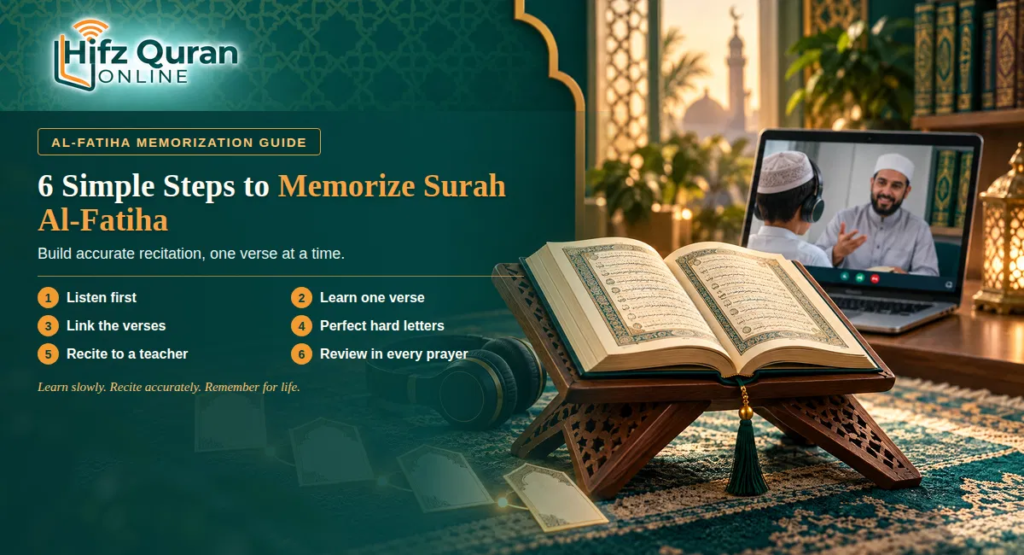
Step 1: Listen To A Good Reciter First
Begin by listening. Before you look at the text, listen to the surah many times. This gives your memory the right sounds to hold on to.
Choose a teaching recitation, known in Arabic as Al-Mushaf Al-Mu’allim (المصحف المعلّم). In this type of recording, the reciter reads each verse slowly, then stops so you can repeat it after him. The best-known example is the teaching recitation by Sheikh Mahmoud Khalil Al-Husary, who recorded it in 1969.
Fast recitations are lovely to hear, but they move too quickly for a beginner to copy.
Start by playing the full surah five times. Just listen and follow the meaning in the table above. Then play it again and pause after each verse, saying it in a low voice. Listen once more at the end of the day, before you sleep.
You can also listen while you do other things. Play it in the car, while you cook, or on a walk. Each time you hear it, the sounds settle a little deeper.
Stick with one reciter for the whole surah. Each reciter has his own pace and tune. If you switch voices, your memory gets mixed signals.
Your memory keeps the sound you repeat most. When you hear it right from day one, you will have nothing to fix later. If you are not sure whose voice to follow, our guide to the best reciter to memorize Quran can help you choose.
Step 2: Learn One Verse At A Time
Give each verse your full focus before you move on. Trying to learn the whole surah at once often leads to mixed-up words.
For each verse, play it once and listen closely. Then look at the verse and say it out loud three times. Close your eyes and say it from memory. If you get stuck, open your eyes, read it, and try again. Stop when you can say it five times in a row with no pause.
Always practice out loud. When you read in your head, small mistakes slip past you. When you say the words, you can hear them.
Think about the meaning as you repeat each verse. When you say verse 2, think of praising Allah. When you say verse 6, think of asking Him for help. A verse you understand is easier to keep.
Verse 7 is the longest, so split it into three parts. Learn each part on its own, then join them:
صِرَاطَ الَّذِينَ أَنْعَمْتَ عَلَيْهِمْ
غَيْرِ الْمَغْضُوبِ عَلَيْهِمْ
وَلَا الضَّالِّينَ
How long should one verse take? A short verse like verse 3 may take a few minutes. Verse 7 may take a full session. Go at the pace that lets you say it with no mistakes.
Step 3: Link Each New Verse To The Ones Before It
Linking (الربط) keeps the verses in the right order. Each time you learn a new verse, you join it to everything you already know. It works like this. Learn verse 1 and say it on its own. Then learn verse 2 and say verses 1 and 2 together. Next, learn verse 3 and say all three together. Keep going this way until you reach verse 7.
Many people can say each verse alone but get stuck between two verses. Linking trains your memory to move from one verse to the next. Pay extra attention to the end of each verse and the start of the next one.
Verses 3 and 4 are a common place to slip. Verse 3 repeats words from verse 1, so some learners jump back to the start by mistake. If this happens to you, say verses 3 and 4 together ten times as a pair.
When you reach the end, say the whole surah from start to finish five times. Do this in one sitting, without looking. If you stop at any point, start again from verse 1.
Step 4: Get The Doubled And Hard Letters Right
Some letters in Al-Fatiha change the meaning if you say them wrong. So check them as you learn, while the habit is still new. Watch these five closely:
- In إِيَّاكَ (iyyaka), verse 5, the ي is doubled. Hold it a little longer. Dropping the shaddah changes the meaning.
- In أَنْعَمْتَ (an’amta), verse 7, end with “ta.” This means “You blessed.” Ending with “tu” means “I blessed.”
- In الْحَمْدُ (al-hamdu), verse 2, start with the deep ح. It comes from the middle of the throat. The light ه is a different letter.
- In الْعَالَمِينَ and نَعْبُدُ, say the letter ع from the throat. Give it its own clear sound.
- In الضَّالِّينَ (ad-dallin), verse 7, say the ض clearly. This word also has two shaddahs.
Al-Fatiha has 14 shaddahs in all. A fun way to check them is to read slowly and tap your finger each time you hit one. If you count 14 taps, you did not skip any.
Another way to check yourself is to record your voice. Then play it back next to the reciter. Listen for any letter that sounds different. Say that word ten times on its own, then put it back into the verse.
Many scholars say this matters for prayer. A mistake that changes the meaning can harm the prayer. This applies when the person is able to learn the right way.
Step 5: Recite It To A Teacher
A teacher can hear mistakes you miss. Over time, your ear gets used to your own voice. A trained teacher still catches every slip.
In one short session, the teacher listens to you recite the whole surah. They point out any letter or shaddah you need to fix. Then they say the correct sound so you can copy it, and ask you to repeat until it is right.
Choose a teacher who knows Tajweed well. A teacher with an Ijazah has had their own recitation checked by a qualified chain of teachers. This means the sound you learn has been passed down with care.
Come to the session ready. Recite the full surah once at home before class. Note any verse that still feels shaky so you can ask about it.
It is far easier to fix a mistake now than after years of prayer. A single check can give you peace of mind for every prayer after it.
Want a tutor to check your Al-Fatiha? Hifz Quran Online Academy tutors are certified Huffaz with an Ijazah. They are native Egyptian men and women who teach in English, one-to-one. Book a free trial class, and a tutor will check your Al-Fatiha verse by verse.

Step 6: Recite the Surah In Every Prayer
Prayer is the best review plan for Al-Fatiha. Once a teacher confirms your recitation, start using it in every prayer right away. You will say it many times each day, so it will settle in your memory fast.
Pray at a calm pace, since fast reading can blur letters you once said well. Pause briefly at the end of each verse to keep each word clear. Once a week, recite it slowly on its own and check the hard letters. Listen to the reciter now and then to refresh the right sounds.
Try to think of the meaning while you pray. When your heart follows the words, your tongue is less likely to rush. You will also find more peace in your prayer.
Al-Fatiha is your first step. As you add more surahs, a steady review routine keeps them all strong. Learn how in our guide on how to memorize Quran without forgetting.
7-Day Plan To Memorize Surah Al-Fatiha
This plan is for adults and older kids. Spend 15 to 20 minutes a day. Short sessions after each prayer work well.
| Day | What to learn | What to check |
| Day 1 | Listen to the full surah 10 times. Learn verse 1. | Say all three shaddahs in the Basmala |
| Day 2 | Learn verse 2. | Link verses 1–2. Practice ح and ع. |
| Day 3 | Learn verses 3 and 4. | Link verses 1–4. |
| Day 4 | Learn verse 5. | Link verses 1–5. Hold the doubled ي in إِيَّاكَ. |
| Day 5 | Learn verse 6 and part 1 of verse 7. | Link from verse 1. Check that أَنْعَمْتَ ends in “ta.” |
| Day 6 | Learn parts 2 and 3 of verse 7. | Say the whole surah 5 times. Check the ض. |
| Day 7 | Nothing new. | Recite to a teacher. Fix any mistakes. Use it in prayer. |
Three rules make the plan work:
- Wait until the last verse is solid before you start a new one. Repeat a day if you need to.
- Start each session by saying everything you already know.
- Keep listening to the reciter all week.
For young kids, stretch each day over two or three days. Spend two or three days on one verse. Then spend two days linking it to the verses before it. The plan then takes about three weeks.
Step Inside Our Virtual Classrooms
Don’t just take our word for it—see how our interactive sessions work! Watch the short clips below to experience our engaging teaching methods, live teacher-student interactions, and the supportive learning environment we bring to every student.
Memorize the Quran at Your Own Pace
Join our expert tutors and begin your Hifz journey with a personalized plan.
Start Your Free TrialRead also: How to Memorize Surah Al-Fajr
How To Teach Surah Al-Fatiha To Young Kids
Young kids learn Al-Fatiha by hearing and copying you, long before they can read Arabic. These steps help parents turn that into a happy daily habit.
Step 1: Choose One Fixed Time Each Day
Pick a time that already fits your child’s day. Bedtime, the car ride to school, or right after breakfast all work well. Keep each session to about five minutes.
Using the same time every day helps your child expect it. Soon it will feel as normal as brushing their teeth.
Turn off screens and other noise during the session. Sit in the same cozy spot each time, like a special Quran corner. A small cushion or a favorite blanket can make that spot feel special. If you miss a day, simply start again the next day without fuss. On busy days, even two minutes keeps the habit alive.
Step 2: Tell Your Child What The Surah Means
Before you start, explain the surah in simple words. You might say: “First we thank Allah. Then we say how kind He is. Then we ask Him to show us the right way.”
A child who knows the story behind the words feels part of it. They are also more likely to remember the order.
Use things your child already knows to explain each idea. For “Lord of all the worlds,” talk about the sun, the trees, and the animals Allah made. For “Master of the Day of Judgment,” keep it simple: one day Allah will reward the good things we do. Let your child ask questions, and answer in short, calm words. One new idea a day is enough.
Step 3: Say A Verse And Let Your Child Repeat It
Sit face to face so your child can see your mouth. Say one verse slowly and clearly, then let your child say it back. This is called talqin (التلقين), and it is how children have learned the Quran for centuries.
If a verse is long, give it in small pieces of two or three words. Join the pieces once your child says each one with ease.
Keep your voice warm and a little slower than normal. Young kids copy your face and tone along with your words. Some children like to whisper the verse first, then say it out loud. Others like to take turns with a sibling or a favorite toy. Let your child pick the way that makes them smile.
Step 4: Play The “Finish The Verse” Game
Once your child knows a verse, start it and then stop. Let your child finish it. For example, say “Al-hamdu lillahi…” and wait for “…Rabbil-‘alamin.”
Little by little, say less and let your child say more. Most kids enjoy this game, and it shows you what they truly remember.
To make it harder, stop earlier in the verse. Sometimes swap roles, so your child starts a verse and you finish it. You can play anywhere, such as in the kitchen or while waiting in line. Short rounds through the day add up. Cheer with claps after each round so your child always feels like a winner.
Step 5: Correct the Mistake Gently
When your child says a word wrong, simply say the right word again with a smile. Then let them try once more. Avoid saying “wrong” or “no,” since young kids can lose interest if they feel they failed.
Praise the effort as much as the result. “You tried so hard on that word!” goes a long way. Fix only one mistake at a time. If there are several, start with the most important one and save the rest for another day.
Keep your tone calm, even when you feel tired. Kids notice when a parent is frustrated, and they may start to avoid the lesson. A quick hug after a correction tells your child that mistakes are okay.
Step 6: Celebrate Each Verse
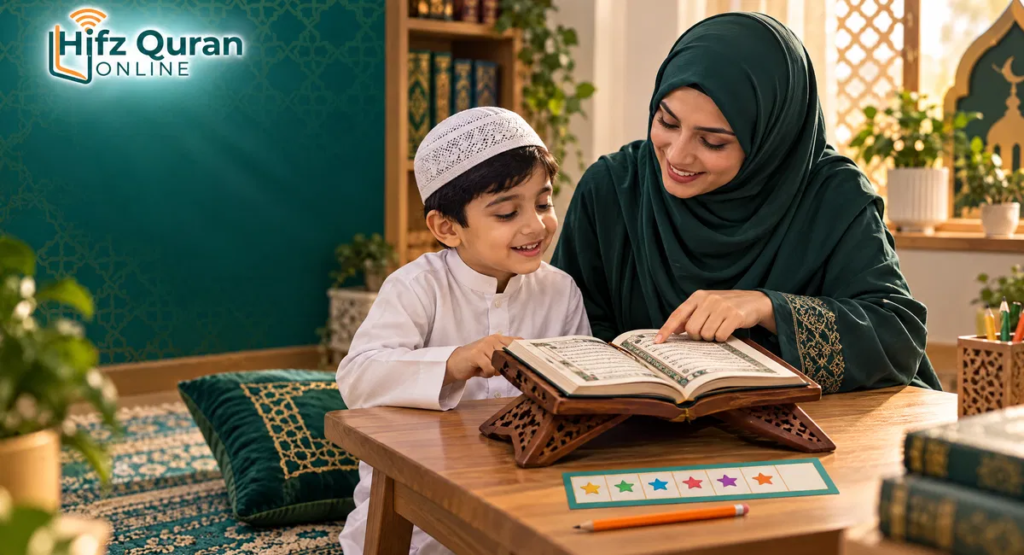
Make a simple chart with seven boxes, one for each verse. Let your child add a sticker each time they learn a new one. When the chart is full, plan a small treat.
You can also invite your child to recite the whole surah to a grandparent or a family friend. Proud listeners give kids a big boost.
Let your child choose the stickers or color in the boxes. The treat does not need to cost money; a trip to the park or an extra bedtime story works well. Record a short video of your child reciting the full surah to keep as a memory.
Tell the family how proud you are while your child can hear. Avoid comparing your child with siblings or cousins, since each child learns at their own speed.
Step 7: Let Your Child Hear the Surah In Your Prayer
Recite Al-Fatiha out loud when you pray at home, so your child hears it often. Invite them to stand beside you and pray along. This shows them why they are learning it and gives them a daily chance to use it.
Explain that when we pray, we are talking to Allah. Young kids may wiggle or look around during prayer, and that is normal at this age.
Guide them gently so prayer never feels like a test. When they are ready, let them say Al-Fatiha out loud next to you in one rak’ah. Thank them warmly afterward so prayer stays a happy memory.
If your child gets bored or stuck
Stop before your child gets tired, even if the session feels short. It is better to end while they are still happy. If they get stuck on one verse for several days, go back to the verses they already know for a while. Then try the hard verse again later.
Tips for adults and new Muslims in Memorizing Al-Fatiha Surah
Adults often learn faster than kids. Their main problem is sound. Many languages have no ح, ع, or ض. If you learn the surah with the wrong sounds, you will need to undo that habit later.
So learn the hard letters first, then memorize. A few short lessons on these sounds make the rest much easier.
New Muslims often ask what to say in prayer before they know Al-Fatiha. A hadith in Sunan Abi Dawud tells of a man who could not learn any Quran yet.
The Prophet ﷺ taught him to say:
سبحان الله، والحمد لله، ولا إله إلا الله، والله أكبر، ولا حول ولا قوة إلا بالله
Subhan Allah, wal-hamdu lillah, wa la ilaha illallah, wallahu akbar, wa la hawla wa la quwwata illa billah.
This means: “Glory be to Allah, all praise is for Allah, there is no god but Allah, Allah is the Greatest, and there is no power and no strength except with Allah.”
Scholars say this is only for the time you are still learning. Ask a trusted scholar about your own case.
Ready to learn Al-Fatiha the right way? The Hifz Quran Online Academy Quran Memorization Course starts with correct sounds and moves at your pace. Classes are live, one-to-one, and open 24/7 for kids and adults. Join the Quran Memorization Course and start today.
Mistakes to avoid when memorizing Al-Fatiha
Most mistakes happen at two points: while you are learning the surah, and later when you use it in prayer. Here is what to watch for at each stage and how to fix it.
While you are learning
Keep your eyes on these mistakes that might heppen during your learning
| Mistake | Why it is a problem | What to do instead |
| Learning only from English letters | They cannot show the sounds of ح, ع, or ض | Learn each sound by ear from a reciter or teacher |
| Reading in your head | Silent reading hides small mistakes | Practice out loud every time |
| Moving on too soon | One weak verse makes the whole surah weak | Start a new verse only when the last one is solid |
| Skipping a teacher’s check | A mistake can stay hidden for years | Recite the full surah to a qualified teacher at least once |
When you recite it in prayer
In prayer, pay attention to these mistakes that can make read Al-Fatiha wrong
| Mistake | Why it is a problem | What to do instead |
| Rushing | Speed blurs letters you once said well | Pray at a calm pace and pause at the end of each verse |
| Dropping shaddahs | إِيَّاكَ can turn into “iyaka,” which changes the meaning | Hold every doubled letter, and check them once a week |
Use the meaning to remember the order
Knowing what the verses mean helps you keep them in order. A Hadith Qudsi in Sahih Muslim explains this. Allah says He has divided the prayer between Himself and His servant into two halves.
When you say الْحَمْدُ لِلَّهِ رَبِّ الْعَالَمِينَ, Allah says, “My servant has praised Me.” For الرَّحْمَٰنِ الرَّحِيمِ, He says, “My servant has lauded Me.” For مَالِكِ يَوْمِ الدِّينِ, He says, “My servant has glorified Me.” For إِيَّاكَ نَعْبُدُ وَإِيَّاكَ نَسْتَعِينُ, He says, “This is between Me and My servant.” For the last two verses, He says, “This is for My servant, and he will have what he asks.”
This gives you a simple map of three parts. Verses 2 to 4 are praise. Verse 5 is a promise to worship Allah alone. Verses 6 and 7 are a request for guidance.
If you lose your place, think about where you are in this talk with Allah. The next verse will follow.
Can Reciting Al-Fatiha Incorrectly Make Your Prayer Invalid?
Yes, in some cases. Al-Fatiha is a pillar of every rak’ah, and the Prophet ﷺ said that whoever does not recite it, his prayer is not valid. Many scholars explain that reciting it with a serious mistake can be like not reciting it properly at all.
Scholars divide mistakes in recitation into two kinds. The first kind is a clear mistake (لحن جلي) that changes a letter, a vowel, or the meaning of a word. Saying “an’amtu” instead of “an’amta” is one example, since it changes “You blessed” into “I blessed.”
The second kind is a hidden mistake (لحن خفي), such as making a sound slightly too short or too long. Hidden mistakes lower the beauty of the recitation, but they do not change the meaning.
The serious concern is with clear mistakes. Many scholars hold that if a person makes a mistake in Al-Fatiha that changes the meaning, and they are able to learn the correct way but do not, their prayer is not valid. This is why the letters and shaddahs in Step 4 deserve so much care.
There is also good news. Allah does not burden a soul beyond what it can bear (Surah Al-Baqarah, 2:286). A new Muslim, a young child, or anyone who is still learning and doing their best is excused for what they cannot yet say correctly.
Their prayer is accepted, in sha Allah, as long as they keep trying to improve.
So the goal is to make an honest effort. Learn the sounds, have your recitation checked by a qualified teacher, and fix what you can. Once you know Al-Fatiha is correct, you can stand in every prayer with peace of mind.
What Is Surah Al-Fatiha?
Surah Al-Fatiha is the first surah of the Quran. Its name means “The Opening.” It has seven verses, and Muslims recite it in every rak’ah of every prayer. You can read and hear the full surah on Quran.com.
Facts about Surah Al-Fatiha
Al-Fatiha is short, but there is a lot to know about it. Some facts tell you where it sits in the Quran and how it was revealed. Others show why the Prophet ﷺ gave it such a high rank among all the surahs
| Fact | Detail |
| Name | Al-Fatiha (الفاتحة), meaning “The Opening” |
| Place in the Quran | Surah 1, the first surah in the Mushaf |
| Number of verses | 7 verses (سبع آيات) |
| Where it was revealed | Makkah, according to most scholars (سورة مكية) |
| First surah revealed? | No. The first verses sent down were from Surah Al-‘Alaq |
| Doubled letters | 14 shaddahs (شدّة), counting the Basmala |
| Times recited each day | At least 17, in the five daily prayers |
Virtues of Al-Fatiha
The Prophet ﷺ called Al-Fatiha the greatest surah in the Quran. He also said nothing like it was revealed in the Torah, the Gospel, or the Psalms.
An angel brought the Prophet ﷺ good news of two lights. No prophet before him was given them. One is Al-Fatiha. The other is the last verses of Surah Al-Baqarah. Al-Fatiha is also used as a ruqyah (رقية) for healing. The Prophet ﷺ approved this when a companion recited it over a sick man.
Allah also praises this surah in the Quran. He says He gave the Prophet ﷺ “seven of the often-repeated verses and the great Quran” (Surah Al-Hijr, 15:87).
In the hadith of the two lights, the angel gave more good news. Each time you recite a letter from them, you will be given what it holds.
Al-Fatiha also shows the best way to make du’a. First you praise Allah. Then you ask Him for what you need.
Even the “Amin” after it brings reward. The Prophet ﷺ said that if your Amin matches the Amin of the angels, your past sins are forgiven (Sahih al-Bukhari 780). You recite it in every prayer, so you can earn these rewards many times a day.
Other Names Of Surah Al-Fatiha
Al-Fatiha has many names. Each one tells you something about it.
| Name | Arabic | Meaning | Why |
| Al-Fatiha | الفاتحة | The Opening | The Quran opens with it |
| Fatihat al-Kitab | فاتحة الكتاب | Opening of the Book | The name used in the hadith on prayer |
| Umm al-Kitab | أم الكتاب | Mother of the Book | It holds the main ideas of the Quran |
| Umm al-Quran | أم القرآن | Mother of the Quran | Same idea, used in Sahih Muslim |
| As-Sab’ al-Mathani | السبع المثاني | The Seven Repeated Verses | Seven verses said in every rak’ah |
| Al-Quran al-‘Azim | القرآن العظيم | The Great Quran | The Prophet ﷺ called it this |
| As-Salah | الصلاة | The Prayer | Prayer depends on it |
| Al-Hamd | الحمد | The Praise | It starts with praise of Allah |
| Ash-Shifa’ | الشفاء | The Cure | It is read for healing |
| Ar-Ruqyah | الرقية | The Healing Recitation | The Prophet ﷺ approved it as ruqyah |
| Al-Asas | الأساس | The Base | It is the base of the Quran |
| Al-Kafiya | الكافية | The One That Is Enough | Named by scholars for its full meaning |
The 7 Verses Of Al-Fatiha In Arabic And English
Here is the full text of Al-Fatiha, one verse per row. Each row shows the Arabic, a guide to saying it, and what it means in English. Keep this table open while you work through the steps below.
| Verse | Arabic | Say it like this | Meaning |
| 1 | بِسْمِ اللَّهِ الرَّحْمَٰنِ الرَّحِيمِ | Bismillahir-Rahmanir-Rahim | In the name of Allah, the Most Merciful, the Most Kind |
| 2 | الْحَمْدُ لِلَّهِ رَبِّ الْعَالَمِينَ | Al-hamdu lillahi Rabbil-‘alamin | All praise is for Allah, Lord of all the worlds |
| 3 | الرَّحْمَٰنِ الرَّحِيمِ | Ar-Rahmanir-Rahim | The Most Merciful, the Most Kind |
| 4 | مَالِكِ يَوْمِ الدِّينِ | Maliki yawmid-din | Master of the Day of Judgment |
| 5 | إِيَّاكَ نَعْبُدُ وَإِيَّاكَ نَسْتَعِينُ | Iyyaka na’budu wa iyyaka nasta’in | You alone we worship, and You alone we ask for help |
| 6 | اهْدِنَا الصِّرَاطَ الْمُسْتَقِيمَ | Ihdinas-siratal-mustaqim | Guide us to the straight path |
| 7 | صِرَاطَ الَّذِينَ أَنْعَمْتَ عَلَيْهِمْ غَيْرِ الْمَغْضُوبِ عَلَيْهِمْ وَلَا الضَّالِّينَ | Siratal-ladhina an’amta ‘alayhim ghayril-maghdubi ‘alayhim wa lad-dallin | The path of those You blessed, not of those who earned Your anger, nor of those who went astray |
The English letters are only a guide. Some Arabic sounds have no English letter, so learn them by ear from a teacher or a good reciter.
Words are not enough?! Look and Judge
Watch how our teachers guide young learners in the Quran Memorization Course for Kids at Hifz Quran Online Academy. In this lesson, a student memorizes Surah An-Nazi’at step by step, using a simple method that makes each verse easier to remember.
Memorize the Quran at Your Own Pace
Join our expert tutors and begin your Hifz journey with a personalized plan.
Start Your Free TrialLearn Al-Fatiha With Hifz Quran Online Academy
Al-Fatiha is the surah you will recite most in your life, so it is worth learning it right from the start. At Hifz Quran Online Academy, a certified teacher listens to every verse you say and helps you fix each mistake before it becomes a habit. Once Al-Fatiha is solid, you can keep going with the same teacher and the same method for the rest of the Quran.
Here is what you get when you join:
- One-to-one live classes, so your teacher hears every word you recite
- Certified Huffaz with an Ijazah, who studied at well-known Islamic universities
- Male and female teachers for kids, women, and men
- Native Egyptian teachers who explain everything in clear English
- The talqin method, where you hear each verse and repeat it until it is right
- A steady review plan, so you keep what you learn
- Classes open 24/7, with 2 to 7 lessons a week, weekends included
- Lessons on Zoom or Skype, from any phone, tablet, or computer
- A certificate signed by the course supervisors when you finish
- Discounts for families with more than one learner
- The freedom to cancel your plan at any time
Your first step is simple. Book a free trial class, recite Al-Fatiha to your teacher, and get clear feedback on every verse.
Book your free trial class today

Our Quran Courses
Have a look at our available classes.
- Quran Memorization Course
- Quran Memorization and Hifz Course for Kids
- Online Quran Memorization Courses for Adults
- Quran Hifz Course for Ladies
- Quran Memorization Course for Men
- Saudi-Based Quran Memorization Courses
- Hifz Teachers
Conclusion
You now have a clear path. Listen first. Learn one verse at a time and link it to the rest. Fix the hard letters and the shaddahs. Have a teacher check you. Then recite it in every prayer.
The 7-day plan turns these steps into a daily habit. Most adults can finish it in a week. Kids can follow the same steps over about three weeks. Both paths lead to an Al-Fatiha you can trust in your prayer.
Measure your progress by how correct your recitation is. A child who takes three weeks and gets every letter right has done well. That careful start will help them for the rest of their life.
Once Al-Fatiha is solid, you are ready for the short surahs of Juz ‘Amma. The same steps work for each one. For a quick plan you can use with your next short surah, see how to memorize a surah in 1 hour. Start with verse 1 today, and let your daily prayers help you keep it for life.
FAQs
Have a look at these Questions with their answers to know more about Surah Al-Fatiha.
Can I Recite Only Al-Fatiha In Prayer?
Yes. A prayer with only Al-Fatiha is valid, since it is the required part of each rak’ah. Adding a surah after it in the first two rak’ahs is Sunnah and is not required. See this IslamWeb fatwa for details.
Is The Basmala Part Of Al-Fatiha?
In the Hafs reading used in most printed copies, yes. The Basmala is verse 1. Other known counts do not number it and split verse 7 into two. Either way, the surah has seven verses.
Does Reading Al-Fatiha 1,000 Times Make Wishes Come True?
No sound hadith says that reading Al-Fatiha 1,000 times will meet your needs. The same is true for any set number. Scholars warn against adding set counts to worship without proof. Instead, make du’a, ask Allah’s forgiveness, give charity, and do good deeds.
Can Al-Fatiha Be Used For Healing?
Yes. A companion once recited Al-Fatiha over a man who had been stung, and the man got better. The Prophet ﷺ approved. Healing comes from Allah alone.IslamWeb explains how to recite it over yourself.
Why Is Al-Fatiha Called The Mother Of The Book?
Al-Fatiha is called Umm al-Kitab, the Mother of the Book. It holds the main ideas of the whole Quran: praise of Allah, worship of Him alone, and asking Him for guidance.
Can I Memorize Al-Fatiha In One Day?
Yes, if you already say Arabic letters well. Kids and beginners usually need more time, because they learn the sounds too. A week gives you time to fix the hard letters before they become a habit.





Leave a Reply