 Memorizing Quran

Surah Al-Falaq is one of the first surahs many Muslims learn. It has only five short verses. Many people say it every day after prayer, in the morning and evening, and before sleep. So it is a good surah to know well.
Still, a short surah can be tricky. Four of its five verses start with almost the same words. Learners often skip a verse or mix two verses up. Some also say a few letters wrong, because English does not have those sounds.
This guide shows you how to learn Surah Al-Falaq step by step. First, you will see how the surah is built, so you always know which verse comes next. Then you will learn one verse at a time and join the verses together.
After that, you will fix the main tajweed rules and set up a plan to review. A 7-day plan at the end shows what to do each day.
This guide is for anyone. You may be a new Muslim, an older learner, or someone who does not speak Arabic. You may be a parent teaching a child. You can start where you are, and go at your own pace.
Step 1: Understand The Pattern Of Surah Al-Falaq (5 Minutes)
Before you learn any words, take five minutes to see how the surah is put together. This will keep you from getting lost later. Verse 1 is the request: you ask Allah to keep you safe.
The other four verses each start with “min sharri,” which means “from the evil of.” Verse 2 names a general harm, the evil of all that Allah made. Verses 3, 4, and 5 name three harms in this order: the night, magic on knots, and envy.
One small tip helps a lot. Verse 2 starts with “min sharri,” but verses 3, 4, and 5 start with “wa min sharri” (and from the evil of). If you lose your place, think about which harm you just said, then move to the next one.
Step 2: Listen To Surah Al-Falaq 10 Times With A Reciter
Listen to the surah at least 10 times before you try to say it. Follow the Arabic text with your eyes as you listen. This way, you copy the right sounds from the start.
Pick one reciter and stay with them, such as Mishary Alafasy or Saad Al-Ghamdi. Beginners may like Mahmoud Khalil Al-Husary’s teaching recording. He pauses after each verse so you can repeat it. You can find these reciters for free on Quran.com.
Notice where the reciter stops, because each stop marks the end of a verse.
If a word sounds unclear, play that verse again a few times. By the last few listens, try to whisper along with the reciter. You can also listen in the car or while you get ready in the morning. These extra listens help, but the 10 times you listen with the text come first.
Step 3: Memorize Surah Al-Falaq One Verse At A Time
Learn each verse with four short rounds, and do five repeats in each round:
- Listen while you look at the verse.
- Read along with the recording.
- Read it on your own.
- Say it from memory with the text covered.
In the last round, count only the repeats with no mistakes. Move to the next verse when you can say it five times in a row without a slip.
This may feel slow at first, but it saves time later, because you won’t have to fix mistakes you already learned. A short verse like verse 2 may take only a few minutes, while the longer verses may take a bit more. If you get tired, take a short break and come back to the same verse.
Ready to learn more than one surah? The Online Quran Memorization Course for Adults at Hifz Quran Online Academy teaches the same verse-by-verse way, with a review system to help you keep what you learn.

Step 4: Link The Verses In The Right Order
Each time you learn a new verse, say the surah from the start up to that verse. Do this three times with no mistakes. For example, after verse 4, say verses 1 to 4 three times.
Starting from “Qul” each time links the verses together. Most mistakes happen between verses, so this step matters.
If you make a mistake while linking, go back and start again from “Qul.” Pay close attention to how each verse begins, since that is where “wa” goes. Take a short pause at the end of each verse, just like the reciter does.
At the start of your next practice, say what you already know from memory before you learn anything new. When you can say all five verses in order three times with no mistakes, you have memorized the surah.
Step 5: Fix 3 Tajweed Rules In Surah Al-Falaq
Tajweed is the set of rules for reading the Quran the right way. Surah Al-Falaq has only a few rules, and they repeat. Focus on these three.
Rule 1: Bounce the last letter of each verse (qalqalah)
When you stop at the end of a verse, give the last letter a small bounce. This is called qalqalah. It happens on five letters: ق ط ب ج د. Every verse in Surah Al-Falaq ends with one of them:
- Verse 1: ٱلْفَلَقْ (al-falaq)
- Verse 2: خَلَقْ (khalaq)
- Verse 3: وَقَبْ (waqab)
- Verse 4: ٱلْعُقَدْ (al-‘uqad)
- Verse 5: حَسَدْ (hasad)
Keep the bounce short and don’t add a vowel after it. Say “waqab,” not “waqaba.”
Rule 2: Hum softly in “min sharri” (ikhfa)
In مِن شَرِّ (min sharri), the letter ن (n) comes right before ش (sh). Don’t say the “n” clearly. Make a soft hum through your nose, then say “sh.” This rule is called ikhfa. You will find مِن شَرِّ in verses 2, 3, 4, and 5, so getting it right once fixes all four.
Rule 3: Don’t say the “l” in “an-naffathat”
In verse 4, the word ٱلنَّفَّٰثَٰتِ is written with ل (l), but you don’t say it. The ن (n) has a shaddah (ّ), so you hum on it for two counts. Say “an-naffathat,” not “al-naffathat.” Compare this with ٱلْفَلَقِ (al-falaq) and ٱلْعُقَدِ (al-‘uqad), where you do say the “l.”
Check your recitation with a teacher
When you are done, record yourself and compare it with your reciter. A teacher can catch the mistakes you can’t hear. If there is no teacher near you, read Can I Memorize the Quran Online? to see how online learning works.
Step 6: Review Surah Al-Falaq So You Don’t Forget It
Learning a surah once is not enough, because memory fades if you don’t use it. A simple review plan helps you keep Surah Al-Falaq for life.
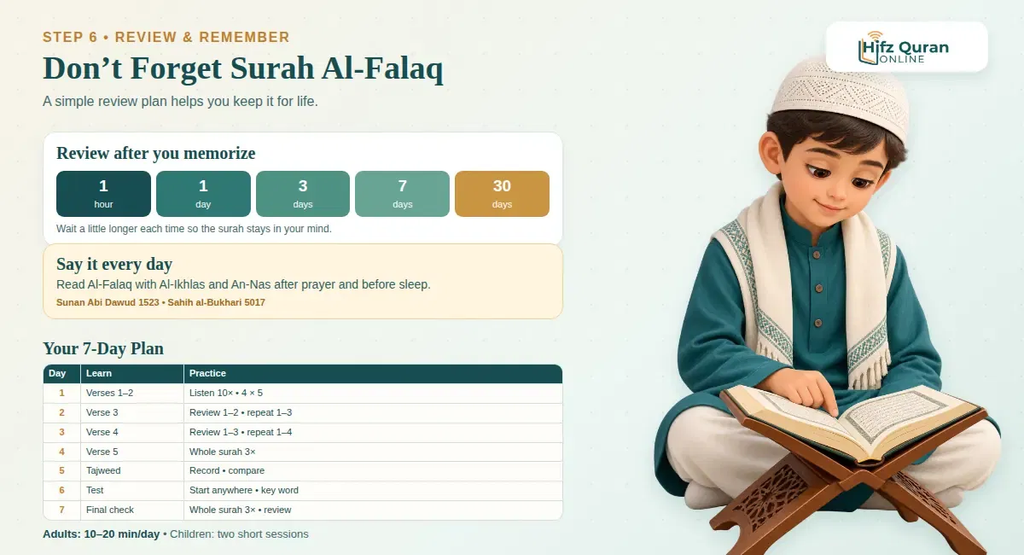
When to review: 1 hour, 1 day, 3 days, 7 days, 30 days
When you know the whole surah by heart, say it again 1 hour later. Then say it the next day, on day 3, on day 7, and on day 30. Each time, you wait a little longer, and this helps the surah stay in your mind. To learn more, read How to Memorize Quran Without Forgetting.
Say Surah Al-Falaq every day
After the first month, your daily worship will help you keep it. The Prophet ﷺ told ‘Uqbah ibn ‘Amir to read the Mu’awwidhat after every prayer (Sunan Abi Dawud 1523).
The Prophet ﷺ also read Al-Ikhlas, Al-Falaq, and An-Nas every night before he slept (Sahih al-Bukhari 5017). If you do the same, you will say Surah Al-Falaq many times each day.
Your 7-Day Plan For Surah Al-Falaq
This plan puts the six steps into one week. Adults often need 10 to 20 minutes a day. Children can split each day into two short practice times.
| Day | What to learn | What to do |
| 1 | Verses 1 and 2 | See how the surah is built (Step 1). Listen 10 times (Step 2). Learn verses 1 and 2 with the 4 × 5 routine. |
| 2 | Verse 3 | Review verses 1 and 2. Learn verse 3. Say verses 1 to 3 three times. |
| 3 | Verse 4 | Review verses 1 to 3. Learn verse 4. Say verses 1 to 4 three times. |
| 4 | Verse 5 | Review verses 1 to 4. Learn verse 5. Say the whole surah three times from memory. |
| 5 | Tajweed | Check each rule in Step 5. Record yourself and compare. |
| 6 | Test yourself | Start from any verse. Do the 10-second key word check. Say Al-Falaq and then An-Nas to make sure you don’t mix them up. |
| 7 | Final check | Say the whole surah three times with no mistakes. Start your review plan. |
Already read Arabic well? You can finish in five days. Join days 2 and 3, and join days 6 and 7. Young children and some older learners may need one verse a day, even on day 1. That is fine. Going slower still gets you there.
Want to see if the academy fits you? Read what other students say and look at the class plans on the Hifz Quran Online Academy homepage. Classes run at times that work in many time zones.
Have a closer look inside our real classes
Watch how our teachers help children build strong recitation skills in the Quran Learning Course for Kids at Hifz Quran Online Academy. In this lesson, a young student learns to recite Surah Al-Qiyamah correctly, verse by verse, with guidance from the teacher.
What You Need to Know About Surah Al-Falaq
Surah Al-Falaq is the 113th surah of the Quran. In it, we ask Allah to keep us safe from harm. Its name means “the daybreak.” This is the moment when morning light comes after the dark night.
Al-Falaq and the next surah, An-Nas, have a shared name: al-Mu’awwidhatayn. It means “the two surahs of seeking safety.” With Al-Ikhlas, the three are called Al-Mu’awwidhat. Al-Falaq asks for safety from harm that comes from outside us, like the dark night, magic, and envy.
| Verse | Arabic | How to say it | Meaning |
| 1 | قُلْ أَعُوذُ بِرَبِّ ٱلْفَلَقِ | Qul a’udhu bi rabbil falaq | Say: I seek protection with the Lord of the daybreak |
| 2 | مِن شَرِّ مَا خَلَقَ | Min sharri ma khalaq | From the evil of what He created |
| 3 | وَمِن شَرِّ غَاسِقٍ إِذَا وَقَبَ | Wa min sharri ghasiqin idha waqab | And from the evil of the night when it grows dark |
| 4 | وَمِن شَرِّ ٱلنَّفَّٰثَٰتِ فِى ٱلْعُقَدِ | Wa min sharrin naffathati fil ‘uqad | And from the evil of those who blow on knots |
| 5 | وَمِن شَرِّ حَاسِدٍ إِذَا حَسَدَ | Wa min sharri hasidin idha hasad | And from the evil of a jealous person when he envies |
The “how to say it” column can help you start. But it can’t show every sound the right way. So always use it with a recording.
Memorize the Quran at Your Own Pace
Join our expert tutors and begin your Hifz journey with a personalized plan.
Start Your Free TrialCommon Mistakes In Surah Al-Falaq And How To Avoid Them
Most mistakes in Surah Al-Falaq come from verses that look alike. Use this table to check your recitation.
| Mistake | Wrong | Right |
| Adding “wa” to verse 2 | wa min sharri ma khalaq | min sharri ma khalaq (مِن شَرِّ مَا خَلَقَ) |
| Leaving out “wa” in verses 3, 4, or 5 | min sharri ghasiqin idha waqab | wa min sharri ghasiqin idha waqab (وَمِن شَرِّ) |
| Adding “idha” to verse 4 | wa min sharrin naffathati idha… | wa min sharrin naffathati fil ‘uqad |
| Mixing up verse 1 with Surah An-Nas | qul a’udhu bi rabbin nas | qul a’udhu bi rabbil falaq |
| Adding a vowel at the end of a verse | waqaba | waqab (a short bounce, no vowel) |
| Saying the “l” in verse 4 | al-naffathat | an-naffathat |
A quick tip: only verses 3 and 5 have the word إِذَا (idha). Verse 4 ends with فِى ٱلْعُقَدِ (fil ‘uqad) instead. If you keep this in mind, you will avoid the most common mix-up.
Most of these slips happen when you recite too fast, so slow down and take a short pause at the end of each verse. Record yourself once a week and check your recitation against this table. If you find a mistake, fix only that one verse first, then say the whole surah from “Qul” three times.
You can also ask a teacher or family member to listen and tell you what they hear. Making mistakes is a normal part of learning, and each one you fix makes your recitation stronger.
How To Teach Surah Al-Falaq To Kids
Children can learn Surah Al-Falaq with the same six steps as adults. These five tips make it easier and more fun for them.
1. Teach One Verse At A Time By Echo
Say a verse out loud, and ask your child to say it back right away. Use the same routine from Step 3, but make each round shorter. Stop while your child is still having fun.
Sit face to face, so your child can watch how your mouth moves. Use a cheerful voice, and let your child copy your tone as well as your words.
Praise your child each time they repeat a verse well. If your child gets restless, switch to a game or activity and come back later. Small children learn best in short bursts, not long lessons.
2. Count The “Min Sharri” Lines On Fingers
Your child raises one finger each time they say “min sharri.” When four fingers are up, the surah is done. This helps them remember how many verses are left.
Begin with a closed hand while your child says verse 1. Then raise one finger for every verse that follows. Turn it into a small game by asking, “How many fingers are up now?” Children enjoy seeing their hand fill up as they reach the end. After a while, your child will know the order without using their fingers.
3. Explain The Meaning In Simple Words
Use pictures from daily life to explain the surah. For example, point to the sunrise and say that Allah brings light after every night. Explain that in this surah, we ask Allah to keep us safe. Young children don’t need to hear details about magic.
Tell your child they can say this surah when they feel scared. Older children can learn what each verse means, one at a time.
Ask your child to tell you the meaning in their own words. Listen closely, and gently correct anything they get wrong. Children who understand what they say often remember it better.
4. Add A Coloring Activity
Coloring sheets work well for young learners. Your child says a verse, then colors the picture for that verse. Each picture becomes a small reward.
For verse 1, your child could color a sunrise. For verse 3, they could color a night sky with stars. Keep all the pages together so your child can see their progress. When the last picture is done, celebrate with a hug or a small treat. Some children also enjoy hanging their finished pages on the wall.
You can also let your child draw their own picture for each verse instead of using a printed sheet. Before your child starts coloring, ask them to say the verse one more time. Later, show your child a picture and ask which verse it goes with, as a fun way to review.
5. Make It Part Of Your Child’s Bedtime Routine
The bedtime recitation from Step 6 works well for children too. Say the surah together each night, at the same time. At first, you lead and your child follows.
Once your child knows it well, let them lead and you follow. Keep this time calm and gentle, with no pressure or testing. If your child misses a word, simply say it with them and keep going. Over time, many children start to recite it on their own without a reminder.
Brothers and sisters can join in, so the whole family recites together. On nights when you are away, a grandparent or another family member can take your place. After the recitation, you can end with a short talk about something your child is thankful for that day.
Virtues Of Surah Al-Falaq From The Sunnah
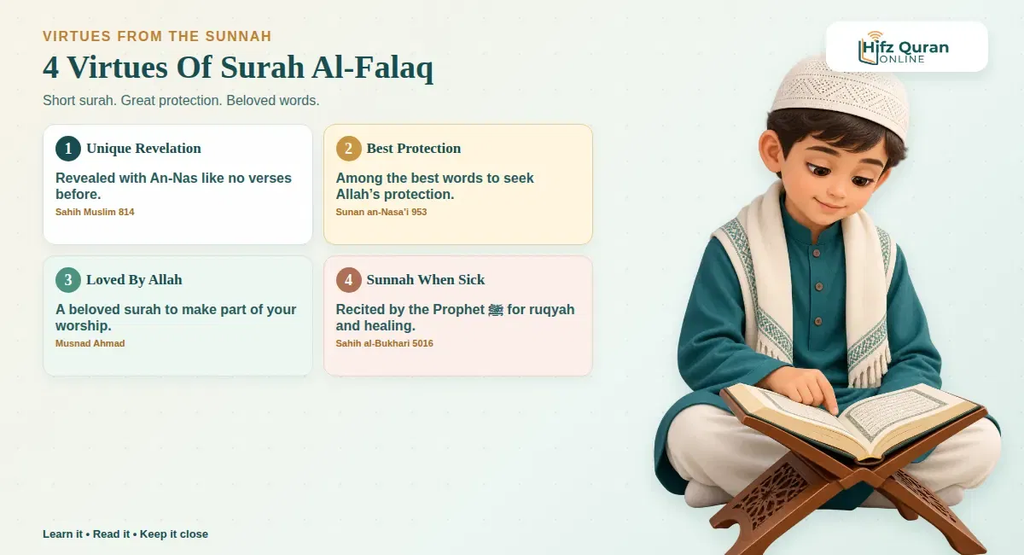
The Prophet ﷺ spoke about Surah Al-Falaq many times. Here are four of its virtues, each from a trusted hadith book.
1. Verses Unlike Any Before Them
The Prophet ﷺ told his companion ‘Uqbah ibn ‘Amir that new verses had come down that night. He said nothing like them had ever been seen before. These verses were Surah Al-Falaq and Surah An-Nas (Sahih Muslim 814).
The two surahs came down on the same night. This is one reason Muslims often learn them one after the other. Both are short, yet each one is a full request for Allah’s protection.
With these words, the Prophet ﷺ showed how high their place is in the Quran. Knowing this can make learning Surah Al-Falaq feel even more meaningful.
2. The Best Words To Seek Allah’s Protection
Once, ‘Uqbah asked the Prophet ﷺ to teach him Surah Hud and Surah Yusuf. The Prophet ﷺ told him that he could never read anything better before Allah than Al-Falaq and An-Nas (Sunan an-Nasa’i 953).
‘Uqbah was walking beside the Prophet ﷺ, who was riding, and he held on to the Prophet’s foot as he asked. Surah Hud and Surah Yusuf are long surahs with many verses. Yet the Prophet ﷺ pointed him to two short ones instead. A surah does not need to be long to have great value. For a beginner, this is good news, because some of the strongest words in the Quran are also among the easiest to learn.
3. A Surah Loved By Allah
In another report, the Prophet ﷺ told ‘Uqbah that no surah he could read was more loved by Allah than Surah Al-Falaq (Musnad Ahmad).
In this report, the Prophet ﷺ named Surah Al-Falaq on its own. Abu ‘Imran, one of the men who passed on this report, never stopped reading the surah after he heard it. He was known to read it in the Maghrib prayer.
When Muslims learn that Allah loves something, they try to make it part of their lives. Reading Surah Al-Falaq in your own prayers is a simple way to start.
4. Recited By The Prophet ﷺ When He Was Sick
‘A’ishah said that when the Prophet ﷺ was sick, he would read the Mu’awwidhat and then blow over his body (Sahih al-Bukhari 5016). The Mu’awwidhat include Surah Al-Falaq and Surah An-Nas.
When his illness became serious, ‘A’ishah read these surahs herself. She then wiped the Prophet’s own hand over his body, hoping for its blessing. Reading the Quran for healing in this way is called ruqyah.
Many Muslims today still read Al-Falaq and An-Nas when they or their family are unwell. If you know the surah by heart, you can say it any time, even when you are too tired or sick to hold a Mushaf.
Checklist: Have You Memorized Surah Al-Falaq?
Use this checklist to see if you know Surah Al-Falaq well. Tick each box only when you can do it with no help.
- I can say the whole surah three times in a row without looking and without a mistake.
- I can start from any verse, not only from “Qul.”
- I know that verse 2 starts with “min sharri,” and verses 3, 4, and 5 start with “wa min sharri.”
- I bounce the last letter of each verse when I stop (Step 5, Rule 1).
- I hum softly in each “min sharri” (Step 5, Rule 2).
- I say “an-naffathat” without the “l” (Step 5, Rule 3).
- I can explain what each verse means in my own words.
- I can recite it to a teacher with no corrections.
Can’t tick a box yet? Go back to the step that covers it and practice only that part. Then try the checklist again in a day or two.
Words are not enough?! Look and Judge
Watch how our teachers guide young learners in the Quran Memorization Course for Kids at Hifz Quran Online Academy. In this lesson, a student memorizes Surah An-Nazi’at step by step, using a simple method that makes each verse easier to remember.
Memorize the Quran at Your Own Pace
Join our expert tutors and begin your Hifz journey with a personalized plan.
Start Your Free TrialLearn Surah Al-Falaq With A Hifz Teacher Today
You can learn the words of Surah Al-Falaq in a week. Saying every letter the right way is harder on your own, because it is hard to hear your own mistakes. A teacher hears them for you and helps you fix them early.
Here is why many learners choose Hifz Quran Online Academy:
- One student, one teacher: Every session is one-on-one, so your Hafiz can catch errors right away, adjust your pace, and plan your review around how you learn.
- Certified Huffaz: All classes are live with certified Huffaz, and the academy focuses only on Quran memorization, not many subjects at once.
- Built for non-Arabic speakers: The academy was designed for Muslims who don’t speak Arabic. You don’t need to know Arabic to join; teachers use the Talqin method, and you can start with Quran reading basics if you need them.
- A review system that stops forgetting: The adult program uses a strong Muraja’ah (review) system so you keep what you have already learned.
- Class times that fit your life: Classes work across time zones, so students in places like London and New York can each learn at times that suit them.
- For every age: The academy teaches children, teens, working adults, and retirees. Programs range from Juz Amma for kids to revision courses for students who have finished Hifz.
- Male and female teachers: Classes are led by qualified native Egyptian male and female teachers.
Your teacher will listen to each verse of Surah Al-Falaq and help you get it right before you move on. Once you finish, you can keep going to the next surah with the same teacher.
Try a free lesson with Hifz Quran Online Academy and start learning Surah Al-Falaq the right way.

Our Quran Courses:
- Quran Memorization Course
- Quran Memorization and Hifz Course for Kids
- Online Quran Memorization Courses for Adults
- Quran Hifz Course for Ladies
- Quran Memorization Course for Men
- Saudi-Based Quran Memorization Courses
- Hifz Teachers
Conclusion
Now you know how to learn Surah Al-Falaq from start to finish. First, you look at how its verses fit together. Then you listen to a reciter, learn one verse at a time, and link each new verse back to “Qul.” After that, you fix three simple tajweed rules.
Review is what helps you keep the surah. Say it again a few times during the first month, with longer gaps each time. After that, reading it after your prayers and before sleep will keep it fresh in your mind.
Don’t worry if you make mistakes along the way. Every learner slips at first, even on a short surah. Go back to the step that helps, practice that part, and try again. With a few minutes each day, most people can learn Surah Al-Falaq in about a week.
A good next surah to learn is An-Nas. It comes right after Al-Falaq, and it starts in almost the same way. Since you already know Al-Falaq well, you will find An-Nas quicker to learn. Use the same steps, and pay close attention to how its first verse ends.
Each short surah you learn adds to the next one. Over time, many learners go on to memorize all of Juz Amma, and some go on to memorize the whole Quran. If you want to keep going, read Who Is a Hafiz? to learn what it means to hold the whole Quran in your heart.
FAQs
Need to know more about Surah Al-Falaq, read these questions and answers.
What Does “Al-Falaq” Mean?
“Al-falaq” means “the daybreak.” It is the moment morning light comes after the dark night. In verse 1 of Surah Al-Falaq, we ask Allah, the Lord of the daybreak, to keep us safe.
Do I Need To Read Arabic To Learn Surah Al-Falaq?
No, you don’t need to read Arabic to start. You can learn Surah Al-Falaq by listening and repeating, with the “how to say it” column to help you. At Hifz Quran Online Academy, students can also start with basic Quran reading if they need it.
Is Surah Al-Falaq A Good Surah For New Muslims?
Yes. Surah Al-Falaq is a good first surah for new Muslims. It is short, easy to follow, and part of daily worship. Many new Muslims learn it along with Al-Fatihah, Al-Ikhlas, and An-Nas.
How Many Minutes A Day Should I Practice?
Most adults need 10 to 20 minutes a day to learn Surah Al-Falaq in a week. Children often do better with two short practice times of 5 to 10 minutes each.
Should I Learn Surah An-Nas At The Same Time?
It is best to learn Surah Al-Falaq first and then Surah An-Nas. The two surahs start the same way, so learning both at once can mix you up. Once you know Al-Falaq well, An-Nas is usually quick to learn.
What Should I Do If I Forget A Verse?
If you forget a verse in Surah Al-Falaq, do the 4 × 5 routine again for that verse only. Then say the surah from “Qul” three times. It is normal to forget at first, and you don’t need to start over.
Can I Learn Surah Al-Falaq On My Phone?
Yes. You can use your phone to listen, follow the Arabic text, and record yourself. To check your tajweed, it is best to read to a teacher, either in person or online.
Related Articles
Memorizing Quran





Leave a Reply