 Memorizing Quran
Learning how to memorize a surah in one day starts with choosing a realistic target. A short Surah from Juz Amma may be memorized and recited from memory within one focused day, while a longer Surah requires a completely different strategy.
The core method is simple: listen first, divide the Surah into manageable blocks, repeat each block while looking at the Mushaf, recall it without looking, connect it to the previous block, and finish the day with full recitation and revision.
The important distinction is between same-day memorization and stable Hifz. Being able to recite a Surah tonight does not automatically mean it will still be secure next week; revision after the memorization day is what turns initial recall into lasting Hifz.
How to Memorize a Surah in One Day Depends First on the Length of the Surah
A one-day Surah memorization plan is an intensive Hifz method that concentrates listening, repetition, active recall, linking, and review into a single day.
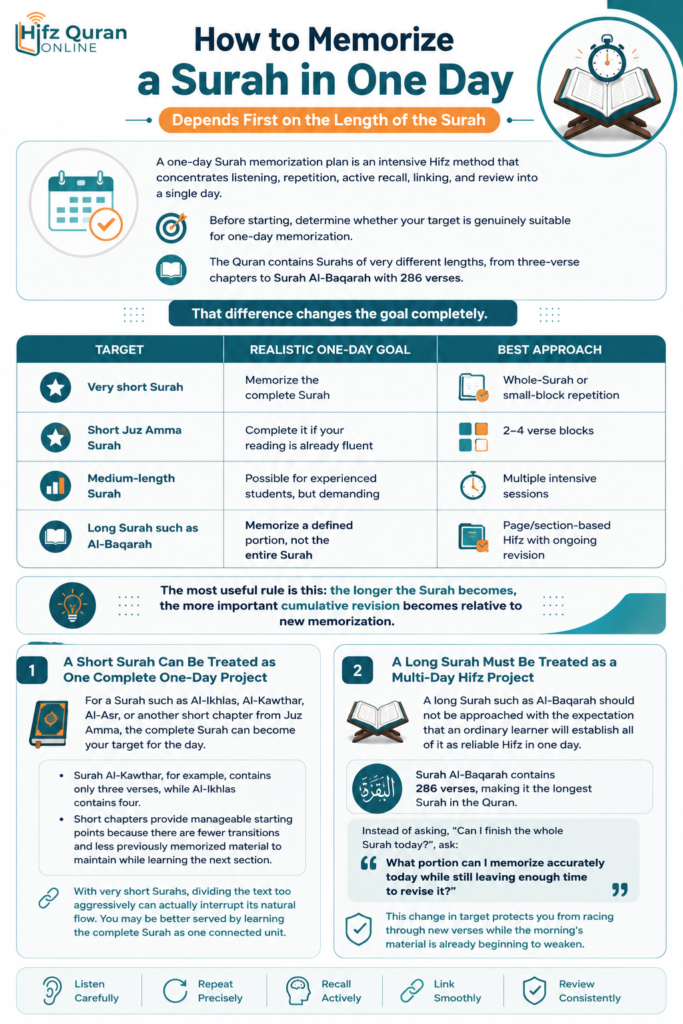
Before starting, determine whether your target is genuinely suitable for one-day memorization. The Quran contains Surahs of very different lengths, from three-verse chapters to Surah Al-Baqarah with 286 verses.
That difference changes the goal completely.
| Target | Realistic One-Day Goal | Best Approach |
| Very short Surah | Memorize the complete Surah | Whole-Surah or small-block repetition |
| Short Juz Amma Surah | Complete it if your reading is already fluent | 2–4 verse blocks |
| Medium-length Surah | Possible for experienced students, but demanding | Multiple intensive sessions |
| Long Surah such as Al-Baqarah | Memorize a defined portion, not the entire Surah | Page/section-based Hifz with ongoing revision |
The most useful rule is this: the longer the Surah becomes, the more important cumulative revision becomes relative to new memorization.
A Short Surah Can Be Treated as One Complete One-Day Project
For a Surah such as Al-Ikhlas, Al-Kawthar, Al-Asr, or another short chapter from Juz Amma, the complete Surah can become your target for the day.
Surah Al-Kawthar, for example, contains only three verses, while Al-Ikhlas contains four. Short chapters provide manageable starting points because there are fewer transitions and less previously memorized material to maintain while learning the next section.
With very short Surahs, dividing the text too aggressively can actually interrupt its natural flow. You may be better served by learning the complete Surah as one connected unit.
A Long Surah Must Be Treated as a Multi-Day Hifz Project
A long Surah such as Al-Baqarah should not be approached with the expectation that an ordinary learner will establish all of it as reliable Hifz in one day.
Surah Al-Baqarah contains 286 verses, making it the longest Surah in the Quran.
Instead of asking, “Can I finish the whole Surah today?”, ask:
“What portion can I memorize accurately today while still leaving enough time to revise it?”
This change in target protects you from racing through new verses while the morning’s material is already beginning to weaken.
Follow This One-Day Method for Short Surahs
For a short Surah, your day should move through severa distinct jobs: familiarity, memorization, connection, testing, and consolidation.
Do not combine them into one endless repetition session. Each stage solves a different memorization problem.
1. Prepare Your Mind and Set Your Intention Before Memorizing
Begin with a sincere intention to memorize the words of Allah, then remove unnecessary distractions before opening the Mushaf.
Choose a quiet place, silence notifications, and decide exactly which Surah you intend to complete. Use one physical Mushaf throughout the day rather than switching between different page layouts.
Your first goal is not speed. It is to give the Surah your complete attention.
2. Listen to the Complete Surah Before Trying to Memorize It
Play a clear recitation of your chosen Surah several times while following the Arabic text in your Mushaf.
For a short Surah, 10 focused repetitions can give your ear familiarity with the order of the verses, pronunciation, pauses, and rhythm before active memorization begins.
Listening first also gives you an auditory model to imitate rather than allowing your own uncertain pronunciation to become the version stored in memory.
3. Divide the Surah Into Blocks of 2–4 Verses
Chunking is the practice of dividing a larger passage into smaller units that can be learned and recalled independently before being connected.
For most short Surahs, begin with blocks of approximately two to four verses. Longer individual verses may need to be divided by lines or natural stopping points instead.
For example:
- Block 1: verses 1–3
- Block 2: verses 4–6
- Block 3: verses 7–9
- Block 4: remaining verses
The exact numbers matter less than making each block small enough to recall accurately.
This principle also appears in structured Surah memorization: longer passages become easier to retain when divided according to meaningful or rhythmic sections rather than treated as one continuous mass.
4. Read Each Block 10 Times While Looking at the Mushaf
Take the first block and read it aloud at least 10 times while looking directly at the Arabic.
Do not rush these repetitions.
Watch the exact words, listen to your pronunciation, and pay attention to where each verse begins and ends. If you repeatedly stumble over one word, isolate that word or phrase before repeating the complete verse again.
The purpose of looking repetitions is accuracy, not merely reaching repetition number ten.
5. Close the Mushaf and Recite the Block 5–10 Times From Memory
Now move from exposure to active recall.
Active recall means deliberately producing information from memory without looking at the answer.
Close the Mushaf and recite your block. If you become stuck, check the exact mistake, close the Mushaf again, and restart.
Continue until you can recite the block correctly several times without assistance.
This “look, close, recall” approach prevents the common illusion in which a verse feels memorized only because your eyes are still following it on the page.
6. Connect Every New Block to the Previous One
Do not memorize Block 1, then abandon it while working on Block 2.
After securing Block 2, recite:
Block 1 → Block 2
Repeat the combined passage approximately five times before moving forward.
After Block 3:
Block 1 → Block 2 → Block 3
This creates what can be called a memorization chain: each new section is attached to material already secured.
The transition between blocks deserves special attention because students can know two sections individually yet stumble when trying to move from one to the other. Structured Hifz methods therefore emphasize connecting sections before advancing.
Use the Meaning of the Surah to Remember What Comes Next
Read a brief translation or summary before or during your memorization session.
Understanding does not replace repetition, but it gives the sequence another memory anchor. Instead of remembering only a chain of unfamiliar Arabic sounds, you begin remembering the progression of ideas.
This becomes increasingly valuable as Surahs become longer.
If one section discusses creation and the next moves to the Day of Judgment, for example, that thematic shift can become a mental signpost telling you what comes next. Memorization guides for longer Surahs similarly benefit from dividing passages according to their natural thematic movements.
Practitioner note: When two passages sound similar, attach a distinctive meaning, keyword, or mental image to each one rather than relying exclusively on rhyme.
Test the Complete Surah Without Looking Before Calling It Memorized
Once every block has been learned and connected, close the Mushaf and recite the complete Surah from beginning to end.
Do this several times rather than accepting one successful attempt.
For an intensive one-day target, aim for 8–10 complete recall attempts across the later part of the day. When you make a mistake, mark the location rather than automatically restarting from verse one every time.
Then drill the weak transition or verse separately.
Your final test should answer three questions:
- Can I begin the Surah without prompting?
- Can I move between every section without stopping?
- Can I recover if I hesitate without immediately opening the Mushaf?
If the answer is yes, you have established strong same-day recall. The next challenge is keeping it.
Step Inside Our Virtual Classrooms
Don’t just take our word for it—see how our interactive sessions work! Watch the short clips below to experience our engaging teaching methods, live teacher-student interactions, and the supportive learning environment we bring to every student.
Memorize the Quran at Your Own Pace
Join our expert tutors and begin your Hifz journey with a personalized plan.
Start Your Free TrialUse Salah and Evening Revision to Consolidate the Surah
Recite your newly memorized Surah in Salah when appropriate.
This forces you to retrieve the verses away from your memorization setup and gives the new Surah an immediate practical place in your worship.
You can also perform one final recitation before sleeping, concentrating especially on the points that caused mistakes during your earlier tests.
Do not assume the work ends at bedtime. Newly memorized material needs continued review after the one-day session; structured Hifz plans make revision a continuing part of memorization rather than an optional extra.
Memorizing a Long Surah in One Day Requires a Different Goal
The phrase “memorize a Surah in one day” becomes misleading when applied to very long chapters.
A learner attempting Al-Baqarah should not simply scale up the short-Surah method by repeating more verses faster. The problem is not only how much new material you can learn; it is how much earlier material you can continue retrieving after several additional hours of memorization.
For a long Surah, one day should represent one completed stage of the project rather than the entire project.
Use Pages or Thematic Sections Instead of Treating the Whole Surah as One Target
Set a defined daily portion according to your existing ability.
That may be several verses, half a page, one page, or another amount you can memorize and revise accurately within the same day.
Then divide that portion again into small units of a few lines or verses.
The sequence becomes:“small block → look-and-repeat → recall → next block → connect → cumulative review”
This is much safer than continuously adding new material until mental fatigue makes the earlier pages unstable.
Give Long-Surah Revision More Time Than Short-Surah Revision
With a three- or four-verse Surah, you can repeatedly test the entire chapter in minutes.
With Al-Baqarah, every new section increases the amount of old material requiring maintenance.
Your schedule therefore needs separate periods for new memorization and revision.
| Part of Day | Main Task |
| Morning | New memorization in small blocks |
| Midday | Connect and test the morning portion |
| Afternoon | Correct weak verses and transitions |
| Evening | Cumulative review rather than heavy new memorization |
| Before sleep | Light recall or listening |
The goal is to end the day with less material that is genuinely secure, rather than more material that only feels familiar.
Avoid These Mistakes When Trying to Memorize Quickly
Speed makes certain Hifz mistakes particularly dangerous because every incorrect repetition reinforces the same error.
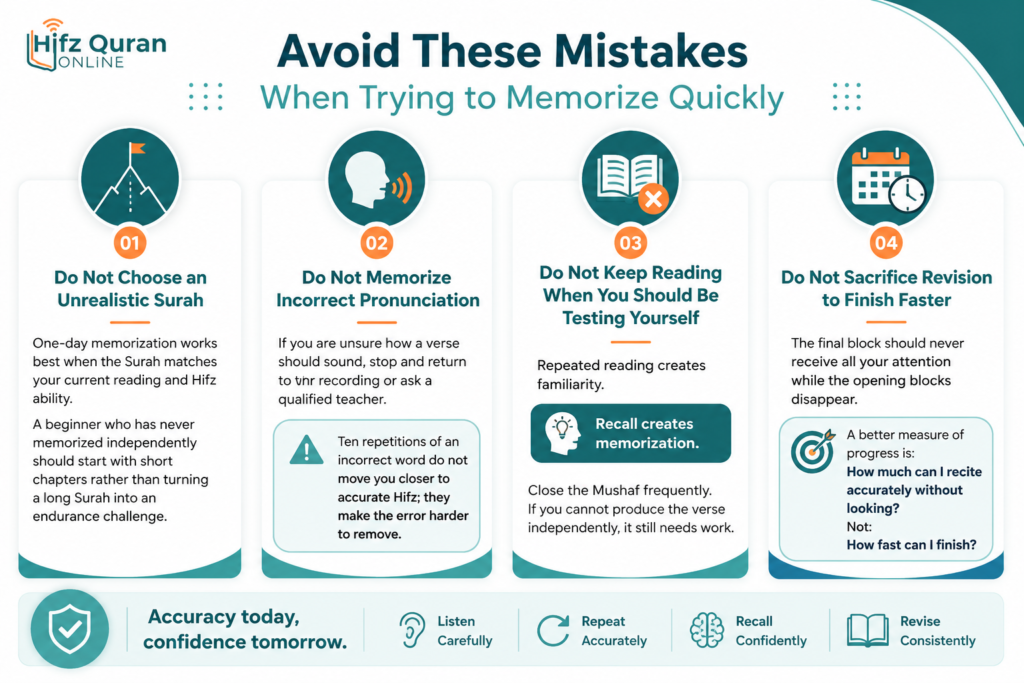
Do Not Choose an Unrealistic Surah
One-day memorization works best when the Surah matches your current reading and Hifz ability.
A beginner who has never memorized independently should start with short chapters rather than turning a long Surah into an endurance challenge.
Do Not Memorize Incorrect Pronunciation
If you are unsure how a verse should sound, stop and return to the recording or ask a qualified teacher.
Ten repetitions of an incorrect word do not move you closer to accurate Hifz; they make the error harder to remove.
Do Not Keep Reading When You Should Be Testing Yourself
Repeated reading creates familiarity.
Recall creates memorization.
Close the Mushaf frequently. If you cannot produce the verse independently, it still needs work.
Do Not Sacrifice Revision to Finish Faster
The final block should never receive all your attention while the opening blocks disappear.
A better measure of progress is:How much can I recite accurately without looking?
Not:How many verses did I cover today?
See Our Classes in Action
Curious about what a 1-on-1 Hifz session looks like? Take a look at these real-time snippets from our daily classes to see our student-centered approach, Tajweed correction techniques, and online whiteboard tools in action.
Start Building Hifz That Lasts With Hifz Quran Online Academy
Finishing a Surah in one day can be an exciting milestone, but lasting Quran memorization requires accurate recitation, structured repetition, consistent revision, and someone who can identify mistakes you may not hear yourself.
At Hifz Quran Online Academy, students can develop a structured Hifz routine with guidance suited to their current level, whether they are beginning with short Surahs or progressing toward longer Quran memorization.
Start your Hifz journey with a plan built for retention, not just speed.
Our Quran Courses
- Quran Memorization Course
- Quran Memorization and Hifz Course for Kids
- Online Quran Memorization Courses for Adults
- Quran Hifz Course for Ladies
- Quran Memorization Course for Men
- Saudi-Based Quran Memorization Courses
- Hifz Teachers
Memorize the Quran at Your Own Pace
Join our expert tutors and begin your Hifz journey with a personalized plan.
Start Your Free Trial
Conclusion
Learning how to memorize a surah in one day is realistic when the target matches your ability. For a short Surah, listen repeatedly, memorize two to four verses at a time, use look-and-close recall, connect each block, test the complete Surah, and recite it in Salah.
For a long Surah such as Al-Baqarah, change the goal. Instead of trying to force hundreds of verses into one day, make each day responsible for a manageable portion plus cumulative revision.
Fast memorization is useful only when tomorrow’s recitation still works.
Frequently Asked Questions
Can you memorize a Surah in one day?
Yes, a short Surah can potentially be memorized in one day through focused listening, repetition, active recall, and revision. Longer Surahs require substantially more time, and same-day recall must still be followed by revision to become stable Hifz.
What is the fastest way to memorize a short Surah?
Listen to the Surah repeatedly, divide it into blocks of two to four verses, read each block around 10 times, then recite it 5–10 times without looking. Connect each new block to the previous one before advancing.
Can I memorize Surah Al-Baqarah in one day?
Memorizing all 286 verses of Surah Al-Baqarah as stable Hifz in one day is not a realistic target for ordinary students. A better approach is to memorize a manageable daily portion and reserve substantial time for cumulative revision.
Should I listen to a Surah before memorizing it?
Yes. Listening before memorization gives you a correct auditory model for pronunciation, rhythm, pauses, and verse endings. Following the Mushaf while listening also combines auditory and visual familiarity before active recall begins.
How do I know if I really memorized the Surah?
Close the Mushaf and recite the complete Surah several times without assistance. You should be able to start independently, move between sections smoothly, and reproduce the verses accurately rather than depending on visual prompts.
Related Articles
Memorizing Quran






Leave a Reply