 Memorizing Quran
Every year, thousands of students attempt Hifz — and most quit not because they lack dedication, but because they lack a proven system. The Mauritania Hifz method solves that problem. Rooted in centuries of unbroken Islamic scholarship from the Shanaqa scholars of West Africa, this approach has produced more Huffaz per capita than virtually any other tradition on earth.
If you’ve been searching for a structured, time-tested method to memorize the Quran — one that scholars have used across generations — the Mauritanian method is worth understanding in full.
What You’ll Learn in This Article
- What the Mauritania Hifz method is and where it comes from
- The exact daily repetition system scholars used (including specific numbers)
- How the Lawh (wooden board) technique works and why it aids retention
- The four-day progressive review schedule in practice
- Common mistakes students make when following this method
- How to apply it online today
What Is the Mauritania Hifz Method?
The Mauritania Hifz method is a traditional Quranic memorization system developed and refined over centuries by the Shanaqa — the Islamic scholars of Mauritania and the Saharan regions of West Africa. It is built on three core principles: intensive repetition, progressive daily review, and direct teacher-to-student transmission through a qualified Sheikh.
Unlike general memorization approaches, the Mauritanian method treats Hifz as a precision craft. The goal is not simply to recite a verse once correctly — it is to drive the text so deeply into memory that it becomes impossible to forget. In the words of scholar Muhammad Salim Al-Adood Al-Shanqeeti: “Make your goal that the text is engraved in your memory — not just held in it.”
The method is also known in scholarly circles as Tariqat Al-Dawr (the method of rotational review), reflecting its defining feature: a structured, daily cycle that reinforces new material while protecting older memorization from fading.
Why do Mauritanian Students Write Before Their Memories?
A defining feature of the Mauritania Hifz method is the use of the Lawh — a wooden board roughly the size of a book, onto which the student writes the day’s verses in ink before beginning memorization.
Scholars who have studied this practice note that Hifz from the Lawh tends to be faster and more durable than Hifz from printed books. The likely reason is multi-sensory encoding: the act of writing the verses by hand activates visual, kinesthetic, and motor memory simultaneously, before the auditory repetition phase begins. The student effectively learns the text three times before the first verbal repetition.
A practitioner’s recommendation from the source material: write the page on paper with a dark background and prop it upright against a wall at eye level. This posture keeps the body alert, mimics the traditional Lawh position, and prevents the drowsiness that comes from reading text laid flat on a desk.
One additional tool used by Mauritanian students: a string of prayer beads (Subha) held during repetition, used purely as a counting device to track repetition cycles accurately. Without an objective count, students consistently underestimate how many times they have actually repeated a passage.
The Mauritania Hifz Daily Repetition System
The core of the Mauritania Hifz method is a specific repetition count that differs sharply from what most students use. Most memorization guides suggest repeating a verse 10–20 times before moving on. The Mauritanian tradition sets a far higher standard.
How Many Times Do Mauritanian Students Repeat Each Page?
The standard repetition target for a single page (one face of a Quran) in the Mauritanian method is 300 repetitions on Day 1, followed by decreasing revision counts on subsequent days. For Quran memorization specifically, scholars in the tradition suggest a minimum of 150 repetitions per new page, with the understanding that deeper repetition dramatically reduces the revision burden later.
To put this in context: at a moderate recitation pace, 300 repetitions of a standard half-page takes approximately 3 hours. A full page at 500 repetitions — the count some Mauritanian scholars used for non-Quranic texts — takes around 4.5 hours. These are not exaggerated figures. Scholar Abu Ishaq Al-Shirazi (d. 1083 CE) reported repeating each unit of the legal text Al-Qiyas one thousand times before moving forward.
The underlying principle: the higher the repetition count at the point of initial memorization, the lower the long-term revision burden. Students who repeat a page 300 times need far less review to maintain it than students who repeat it 20 times and rely on frequent re-memorization.
The Four-Day Progressive Review Schedule
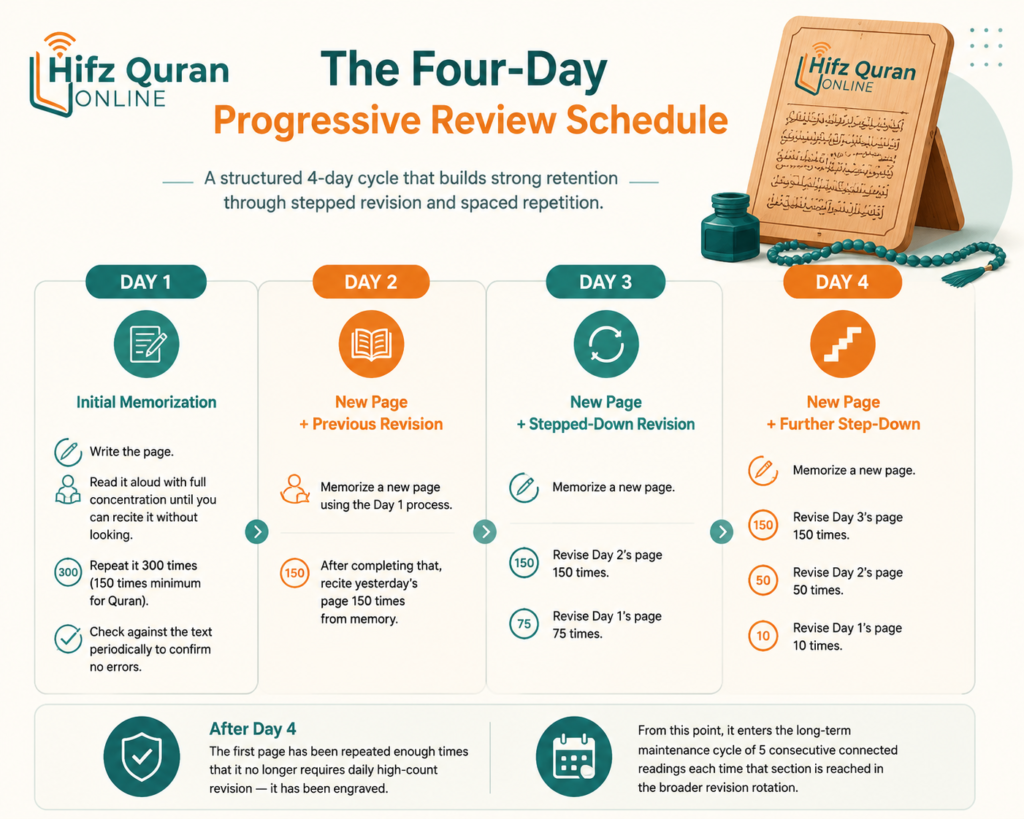
The Mauritanian method structures the first four days after memorizing any new page as follows:
Day 1 — Initial Memorization Write the page. Read it aloud with full concentration until you can recite it without looking. Then repeat it 300 times (or 150 times minimum for Quran). Check against the text periodically to confirm no errors have crept in.
Day 2 — New Page + Previous Revision Memorize a new page using the Day 1 process. After completing that, recite yesterday’s page 150 times from memory.
Day 3 — New Page + Stepped-Down Revision Memorize a new page. Revise Day 2’s page 150 times. Revise Day 1’s page 75 times.
Day 4 — New Page + Further Step-Down Memorize a new page. Revise Day 3’s page 150 times. Revise Day 2’s page 50 times. Revise Day 1’s page 10 times.
After Day 4, the first page has been repeated enough times that it no longer requires daily high-count revision — it has been engraved. From this point, it enters the long-term maintenance cycle of 5 consecutive connected readings each time that section is reached in the broader revision rotation.
Step Inside Our Virtual Classrooms
Don’t just take our word for it—see how our interactive sessions work! Watch the short clips below to experience our engaging teaching methods, live teacher-student interactions, and the supportive learning environment we bring to every student.
Read Also: How to Memorize a Page of the Quran in 5 – 30 minutes?
The Role of the Sheikh in the Mauritanian Method
The Mauritania Hifz method is not a self-study system. It depends on a direct relationship with a qualified, Ijazah-certified Sheikh — a teacher connected to an unbroken chain of Quranic transmission.
The Sheikh fulfills three roles self-study cannot replace: correcting errors before repetition embeds them, monitoring Tajweed during memorization, and adjusting daily targets to the student’s real retention speed.
The most important rule in the tradition: a student does not advance until the previous passage is demonstrated to the Sheikh without error. Students who attempt the method independently almost always fail here — they move forward too soon, and errors compound silently across hundreds of repetitions
Read also How to Help Your Kids Memorize the Quran
Memorize the Quran at Your Own Pace
Join our expert tutors and begin your Hifz journey with a personalized plan.
Start Your Free TrialGroup Revision The Mauritanian Collective Study Session
One component of the Mauritanian method that most outside sources overlook is the group revision session In this practice, students who are studying the same text gather together. Each student takes a turn reciting what they have memorized and explaining its meaning in their own words — starting with the eldest or most senior in the group. Other students correct errors, add points the reciting student may have missed, and benefit from hearing the explanation multiple times. In a group of six or seven students, each person hears the same passage explained six or seven times from different angles.
The practical benefit beyond repetition: students develop the ability to speak and explain under the pressure of an audience — a skill that reinforces active recall rather than passive recognition. Students who can teach a passage they’ve memorized have, by definition, memorized it to a higher standard than students who can only recite it.
Group sessions in the Mauritanian tradition are kept to 15 minutes per student — enough to recite and explain, not so long that attention wanes.
What the Mauritanian Method Gets Right That Most Systems Miss?
Most Hifz programs separate memorization and revision into two stages. The Mauritanian method rejects this — revision begins on Day 2, so by the time a student finishes a Juz’, every earlier page has already received weeks of structured review.
The method also embeds an understanding phase: after memorizing a passage, the student visits the Sheikh for explanation (Sharh), writes it in their own words, and recites both the text and the Sharh from memory the next day. This encodes meaning alongside words — producing Huffaz who understand what they recite, not just hold it.
See Our Classes in Action
Curious about what a 1-on-1 Hifz session looks like? Take a look at these real-time snippets from our daily classes to see our student-centered approach, Tajweed correction techniques, and online whiteboard tools in action.
Start Your Hifz with the Structure This Method Demands
The Mauritanian method is one of the most rigorous and proven systems in Islamic history — but its power depends entirely on one condition: a qualified teacher who can correct errors, set accurate targets, and enforce the review cycle.
At Hifz Quran Online Academy, our Ijazah-certified instructors apply structured repetition systems drawn from classical Hifz traditions, including the principles of the Mauritanian method. You receive personalized daily targets, weekly retention testing, Tajweed correction during memorization, and a revision schedule that protects what you’ve already earned.
Whether you’re a beginner who has never memorized a Surah or an adult who started Hifz years ago and stalled — structured guidance changes everything.
Choose the program that fits your needs:
- Quran Memorization Course (comprehensive Hifz for all ages)
- Quran Memorization and Hifz for Kids
- Online Quran Memorization Courses for Adults
- Quran Hifz for Ladies.
[Enroll in Your Free Trial Lesson Today]
Memorize the Quran at Your Own Pace
Join our expert tutors and begin your Hifz journey with a personalized plan.
Start Your Free TrialConclusion
The Mauritania Hifz method is not a shortcut — it is the opposite. It demands higher repetition counts, stricter error-checking, and more systematic revision than most students are initially willing to commit to. But those demands are precisely what make it work. Scholars from Ibn Kathir to Al-Shirazi validated through their own practice what the Mauritanian tradition formalized into a teaching system: the Quran is not memorized by reading it many times. It is engraved by repeating it until forgetting becomes structurally impossible.
The four-day schedule, the Lawh technique, the Sheikh’s role in correction, and the group revision practice are not separate tips — they are interlocking parts of a single system. Removing any one of them weakens the whole. Applied together, they explain why Mauritanian students have consistently produced some of the world’s most accurate and durable Huffaz across centuries of tradition.
Frequently Asked Questions
What is the Mauritania Hifz method?
The Mauritania Hifz method is a traditional Quranic memorization system from West Africa’s Shanaqa scholars, built on intensive repetition (typically 150–300 times per new page), progressive daily review, and direct learning from an Ijazah-certified Sheikh. It is also called Tariqat Al-Dawr because of its structured rotational review cycle.
How many times do you repeat a verse in the Mauritanian method?
The Mauritanian tradition recommends a minimum of 150 repetitions per new Quranic page on Day 1, with some scholars applying up to 300–500 repetitions for non-Quranic texts. The high initial repetition count is what reduces long-term revision burden and prevents forgetting.
Can I follow the Mauritanian Hifz method without a teacher?
You can apply its repetition and review principles independently, but the method is designed around teacher supervision. The Sheikh’s primary role is to catch recitation errors before they are embedded through hundreds of repetitions — a function that cannot be replicated by self-assessment alone.
How long does the Mauritanian method take to complete the Quran?
Timeline varies by daily target and individual pace. Scholars in the tradition who completed Hifz at the standard pace typically took four to six years. Students who follow the method consistently with a qualified teacher and maintain the revision schedule can progress steadily without losing earlier memorization.
What is the Lawh in the Mauritanian method?
The Lawh is a wooden board used by students in the Mauritanian tradition to write Quranic verses before memorizing them. Writing the text by hand before repetition activates multiple memory channels simultaneously — visual, kinesthetic, and motor — making the initial encoding faster and more durable than reading alone.
Is the Mauritanian Hifz method suitable for adults?
Yes. The method’s emphasis on structured repetition and teacher accountability makes it particularly effective for adult learners, who tend to need higher repetition counts than children but benefit more from the understanding (Sharh) phase. Adults who follow the method under qualified supervision regularly complete Hifz despite starting later in life.
Related Articles
Memorizing Quran







Leave a Reply