 Memorizing Quran

How hard is it to memorize the Quran? It is hard in the first month — and far more achievable than most people believe by the third. The real obstacle is rarely commitment; it is the absence of a methodology designed specifically for non-Arabic speakers who are encountering Arabic phonology for the first time.
The honest answer is that Quran memorization is genuinely demanding, but its difficulty is largely structural, not fixed. When students understand why memorization feels hard and respond with the right techniques, the process becomes steady and measurable. Most adult students who approach Hifz with a proper system retain their memorization for life.
Is It Hard to Memorize the Quran as a Non-Arabic Speaker?
Memorizing the Quran as a non-Arabic speaker is harder than it is for native Arabic speakers — but it is not prohibitively difficult. The primary challenge is phonetic, not cognitive.
Your brain must simultaneously encode unfamiliar sounds, new vocabulary, and precise pronunciation rules before stable memorization can even begin.
For native Arabic speakers, Hifz benefits from years of passive linguistic exposure. They recognize root words, anticipate sentence rhythm, and process Quranic text with existing neural pathways.
Non-Arabic speakers begin without those pathways, which means the early weeks of memorization require more repetition to achieve the same retention depth.
What Makes the Early Weeks of Quran Memorization the Hardest
The first four to six weeks are consistently the most difficult phase. Students at Hifz Quran Online Academy across multiple demographics — adults, teenagers, and working professionals — report the same pattern: initial sessions feel like attempting to hold water in open hands. Words do not stick, sequences blur together, and confidence drops quickly.
This is neurologically normal. The brain is forming entirely new phonological categories. Once those categories stabilize — typically by weeks five through eight — retention improves noticeably and memorization begins to feel cumulative rather than repetitive.
Book a FREE session with one of our Ijazah-certified teachers
Why Is Memorizing Quran So Hard?
Memorizing Quran feels so hard primarily because most students are attempting it without a methodology built for their specific challenges.
The Quran contains 6,236 verses across 114 Surahs, with recurring phonetic patterns that are easy to confuse and precise Tajweed rules that affect both correctness and memorization stability.
There are four structural reasons the difficulty is higher than students anticipate:
1. Phonetic Overload in the Early Stages
Arabic Makhraj — the precise articulation points of each letter — demands muscular memory that English speakers have never developed. Letters like ع (Ayn), غ (Ghayn), ح (Ha), and ق (Qaf) have no equivalent in English phonology.
Until pronunciation is stable, the brain cannot form reliable memory traces. This is why Tajweed correction must happen before aggressive memorization begins, not alongside it.
2. Verse Similarity and Sequence Confusion
Many Surahs contain verses that share nearly identical wording with slight differences. Surah Al-Baqarah alone contains numerous verse pairs that differ by a single word or letter.
Without the Rabṭ technique — consciously connecting the final word of each verse to the opening word of the next — students consistently lose their sequence. This confusion is one of the most common errors I observe in new students, and it is entirely preventable with structured practice.
Shots Videos from Our Courses
Memorize the Quran at Your Own Pace
Join our expert tutors and begin your Hifz journey with a personalized plan.
Start Your Free Trial3. Absence of Structured Muraja’ah from Day One
Most students who describe memorizing Quran as “impossible” share one characteristic: they neglected revision in the first weeks and attempted to add new material continuously. Muraja’ah — systematic daily revision of previously memorized portions — must begin from the very first lesson.
The forgetting curve is aggressive; without revision within 24 hours, retention drops dramatically regardless of how many times a verse was repeated during initial memorization.
4. Unrealistic Daily Targets
Attempting to memorize a full page per day as a beginner is one of the fastest paths to abandoning Hifz entirely. A sustainable rate for most non-Arabic adult beginners is 3–5 lines per session. The goal in the first three months is not speed — it is building stable, retrievable memory that will hold for years.
For families supporting younger learners, Hifz Quran Online Academy’s Quran Memorization and Hifz for Kids uses age-calibrated daily targets that protect against this exact burnout pattern, building children’s confidence progressively rather than overwhelming them at the start.
Start your child’s Hifz today with a free lesson

How to Ease the Hardness When Memorizing the Quran?
The difficulty of Quran memorization is not a fixed wall — it is a set of specific, addressable challenges. Applying the right techniques at the right stage reduces the experience from overwhelming to manageable, and eventually, to deeply rewarding.
| Challenge | Root Cause | Solution |
| Words not sticking | Insufficient repetition cycles | 20–30 focused repetitions per verse before moving on |
| Sequence confusion | Missing Rabṭ practice | Connect end of each verse to start of next, always |
| Forgetting old portions | No structured Muraja’ah | Revise previous pages before any new memorization |
| Pronunciation instability | Tajweed not corrected early | Fix Makhraj errors before memorizing new verses |
| Motivation dropping | Targets too large | Reduce to 3–5 lines daily; track cumulative progress |
1. Timing Your Sessions Around Fajr
Students who memorize immediately after Fajr prayer consistently demonstrate stronger retention in our weekly assessments at Hifz Quran Online Academy. The post-Fajr mind is rested, distraction is minimal, and the sacred context of the time deepens engagement with the text.
Evening memorization is better than no memorization — but Fajr sessions produce measurably superior long-term retention for most students.
Memorize the Quran at Your Own Pace
Join our expert tutors and begin your Hifz journey with a personalized plan.
Start Your Free Trial2. Maintaining the 1:5 Revision Ratio
For every one new page memorized, five previously memorized pages should be revised the same day.
This ratio feels counterintuitive to students focused on progress, but it is what separates students who complete Hifz from those who reach three Juz and collapse under the weight of forgotten material.
The Prophet ﷺ described the importance of consistent connection with the Quran:
“تَعَاهَدُوا هَذَا الْقُرْآنَ فَوَالَّذِي نَفْسُ مُحَمَّدٍ بِيَدِهِ لَهُوَ أَشَدُّ تَفَصِّيًا مِنَ الإِبِلِ فِي عُقُلِهَا”
“Keep refreshing your knowledge of the Quran, for by Him in Whose Hand is Muhammad’s life, it is more liable to escape than camels that are hobbled.” (Sahih al-Bukhari 5033)
This hadith is not a warning about spiritual failure — it is a factual description of how human memory works. Even the strongest memorization requires continuous Muraja’ah to remain stable.
Read Also: How to Help Your Kids Memorize the Quran
3. Using Listening to Reinforce What You Memorize
Passive audio reinforcement between active memorization sessions accelerates retention significantly. Listening to a reliable reciter — particularly one with measured Tarteel recitation — while following the Mushaf creates a secondary memory trace that supports recall during revision.
This technique is especially effective for non-Arabic speakers because it trains the ear to catch phonetic errors before they become embedded in memorized text.
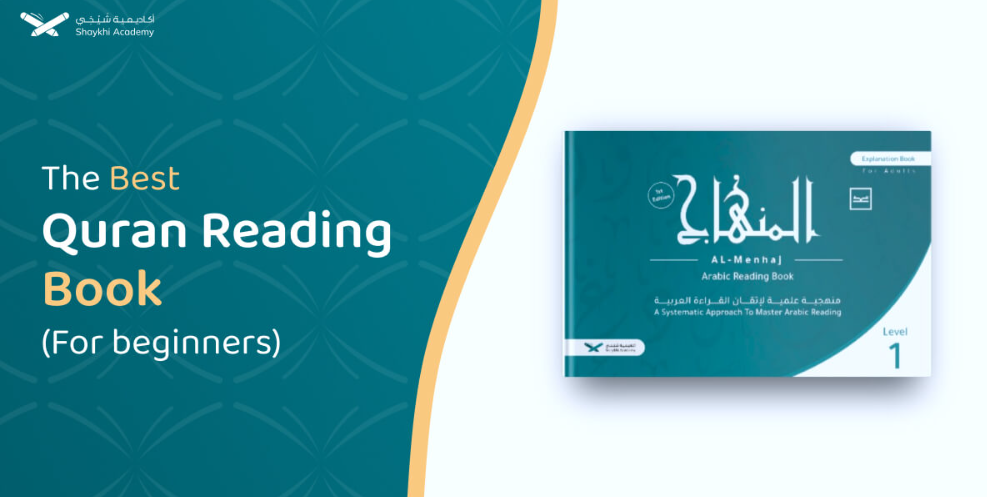
For students who are not yet reading Arabic with confidence, the Al-Menhaj Book — authored by Luqman ElKasabany and developed by instructors with 25+ years of experience — provides the foundational reading prerequisite before Hifz begins. Attempting to memorize without solid reading fluency multiplies difficulty unnecessarily.
Explore and Study Al-Menhaj Book for FREE
Read Also: How to Memorize a Page of the Quran in 5 – 30 minutes?
A Realistic Quran Memorization Timeline for Non-Arabic Speakers
Understanding what to expect at each stage reduces anxiety and prevents students from abandoning Hifz because their progress does not match unrealistic benchmarks.
| Stage | Timeline | Daily Target | Focus |
| Foundation | Months 1–3 | 3–5 lines | Tajweed correction, building routine |
| Early Hifz | Months 4–9 | 5–7 lines | Juz 30 stabilization, Muraja’ah habit |
| Intermediate | Year 1–2 | Half page | Expanding memorization, 1:5 revision ratio |
| Advanced | Year 2–4 | Full page | Increasing new memorization with full revision |
| Completion | Year 4–6 | Revision-heavy | Stabilizing complete Hifz, Khatm preparation |
These timelines reflect genuine instructional observations, not idealized projections. Students in Hifz Quran Online Academy’s Online Quran Memorization Courses for Adults who maintain consistent daily sessions at the targets above typically reach Juz Amma stabilization within three to four months — a milestone that significantly boosts long-term confidence.
Enroll in our Quran Memorization Course for Adults with a free trial

Allah ﷻ reminds us in the Quran about the accessibility He has built into His Book:
“وَلَقَدْ يَسَّرْنَا الْقُرْآنَ لِلذِّكْرِ فَهَلْ مِن مُّدَّكِرٍ”
“Wa laqad yassarnal-Qur’āna lidhdhikri fahal min muddakir”
“And We have certainly made the Quran easy for remembrance, so is there any who will remember?” (Surah Al-Qamar 54:17)
This verse is not rhetorical decoration. It is a documented reality in the Hifz classroom: students who approach memorization with the right system genuinely find that the Quran accommodates their effort in ways that other forms of memorization do not.
For those looking to build a complete daily structure, our detailed guide on Quran memorization schedules provides day-by-day frameworks adaptable to different life situations.
Our Students Reviews
Memorize the Quran at Your Own Pace
Join our expert tutors and begin your Hifz journey with a personalized plan.
Start Your Free TrialRead Aldo: How to Start Memorizing Quran?
Start Your Hifz with the Support It Deserves at Hifz Quran Online Academy
The difficulty of Quran memorization decreases sharply when you have a certified instructor correcting your Tajweed, calibrating your daily targets, and structuring your Muraja’ah from lesson one.
Hifz Quran Online Academy offers:
- Certified Huffaz with verified credentials and proven teaching methodology
- Personalized 1-on-1 instruction tailored to your pace and schedule
- Flexible scheduling across all global time zones
- Structured programs for adults, children, and ladies
- A free trial lesson — no commitment required
Book your free trial lesson today and begin your Hifz with a system that is built for you.
Choose the program that fits your needs:
- Quran Memorization Course
- Quran Memorization and Hifz for Kids
- Online Quran Memorization Courses for Adults
- Quran Hifz for Ladies.
Book your free trial lesson today and begin your journey to Hifz with expert guidance every step of the way.
Memorize the Quran at Your Own Pace
Join our expert tutors and begin your Hifz journey with a personalized plan.
Start Your Free TrialRead Also: Can I Memorize the Quran Online?
Frequently Asked Questions About How Hard It Is to Memorize the Quran
How long does it realistically take to memorize the full Quran?
Most non-Arabic adult learners who maintain daily 30–45 minute sessions complete full Quran memorization within four to six years. Students with more daily time or prior Arabic reading fluency may complete it in three years. The variable is consistency of practice and structured Muraja’ah, not natural ability or age.
Is it hard to memorize the Quran if you cannot read Arabic fluently?
Yes — attempting Hifz without solid Arabic reading fluency significantly increases difficulty. Fluent reading allows the brain to process text and sound simultaneously, accelerating memorization. Students who cannot yet read Arabic confidently should complete a structured reading program first. The Al-Menhaj Book is specifically designed for this prerequisite stage.
Can adults memorize the Quran as effectively as children?
Adults can absolutely complete full Quran memorization and retain it for life. Children have phonological plasticity advantages in the early stages, but adults possess superior comprehension, discipline, and motivational clarity. Many of the most stable Huffaz complete their memorization as adults. A guide on how to become a Hafiz covers the adult pathway in detail.
What is the most common reason students stop memorizing the Quran?
The most common reason is the collapse of Muraja’ah. Students push forward with new memorization while neglecting revision, until previously memorized portions deteriorate to the point where the accumulated loss feels unrecoverable. This is preventable. Rebuilding a Muraja’ah system — even after a long gap — is always possible, and our guide on how to revise memorized Quran addresses exactly this situation.
How many pages per day should a beginner memorize?
Beginners should target three to five lines per day — not a full page. This rate may feel slow, but it produces stable, retrievable memorization that accumulates reliably over months. Students who begin at half a page per day or more typically experience quality collapse within the first two Juz, regardless of how capable they are.
Related Articles
Memorizing Quran






Leave a Reply