 Memorizing Quran
| Key Takeaways |
| A Quran memorization certificate is an official credential issued upon completing full Hifz with verified Tajweed accuracy and tested recall. |
| The Sanad — a chain of transmission — connects a Hafiz to the Prophet ﷺ through an unbroken line of verified teachers and certified scholars. |
| Hifz completion certificates issued by accredited online academies are increasingly recognized by Islamic institutions and mosques worldwide. |
| Earning a Hafiz certificate requires passing oral examination of all 30 Juz’ before a qualified, certified instructor with Ijazah authority. |
| A structured Hifz program with certified Huffaz significantly increases the likelihood of earning a verifiable, institutionally recognized certificate. |
Every year, thousands of non-Arabic speaking Muslims complete their Quran memorization without ever receiving a formal Quran memorization certificate — not because they didn’t earn one, but because they didn’t train within a structured, credentialed program from the start. That distinction matters more than most students realize when they’re sitting with their first new lesson.
A Hifz completion certificate is not merely a piece of paper. It is documented proof of oral mastery, Tajweed precision, and chain-verified transmission — a credential that opens doors to teaching, leading Tarawih, and pursuing advanced Islamic study. The certificate you receive, and whether it carries institutional weight, depends entirely on how and where you memorize.
What Is a Quran Memorization Certificate?
A Quran memorization certificate is a formal document issued to a student who has completed the memorization of the entire Quran with verified Tajweed accuracy and demonstrated consistent oral recall before a qualified examiner. It is not self-issued — legitimacy comes from the authority of the issuing instructor or institution.
Who Issues Quran Memorization Certificates?
Certificates are issued through several channels: traditional Islamic institutes, Al-Azhar affiliated programs, and — increasingly — accredited online Hifz academies whose instructors hold verified Ijazah credentials.
The certificate’s value is directly tied to the qualifications of the instructor who examined and signed it. A student examined by a certified Hafiz with an unbroken Sanad carries a credential recognized far beyond a classroom award.
What Information Does a Hifz Certificate Typically Include?
A legitimate Hifz certificate generally documents the student’s full name, the Qira’ah (recitation mode) in which they memorized — most commonly Hafs ‘an ‘Asim — the name and credentials of the examining instructor, the issuing institution, and the date of completion. Some certificates include the instructor’s Ijazah chain reference, directly connecting the student’s credential to the scholarly transmission lineage.
Shots Videos from Our Courses
Memorize the Quran at Your Own Pace
Join our expert tutors and begin your Hifz journey with a personalized plan.
Start Your Free TrialWhat Is a Sanad in Hifz and Why Does It Define Your Certificate’s Value?
The Sanad Hifz ul Quran is an unbroken chain of oral transmission linking a student’s memorization back to the Prophet Muhammad ﷺ through an authenticated line of scholars. It is the highest mark of Quranic credential authenticity in the Islamic scholarly tradition.
When your examining instructor holds a verified Sanad — meaning their recitation has been orally certified by their teacher, who was certified by their teacher, in an unbroken line — that chain of authority extends to the certificate they issue you. This is why two students with identical memorization quality may hold certificates of vastly different institutional and scholarly weight: one examined by a Sanad-holding Hafiz, another by an uncredentialed teacher.
How Does Sanad Transmission Work in Practice?
When a student completes their full Hifz review — reciting the entire Quran from memory before their instructor — the instructor makes a formal declaration of Ijazah. This certifies that the student’s recitation meets the transmission standard. The instructor then issues a written Ijazah document that references their own chain.
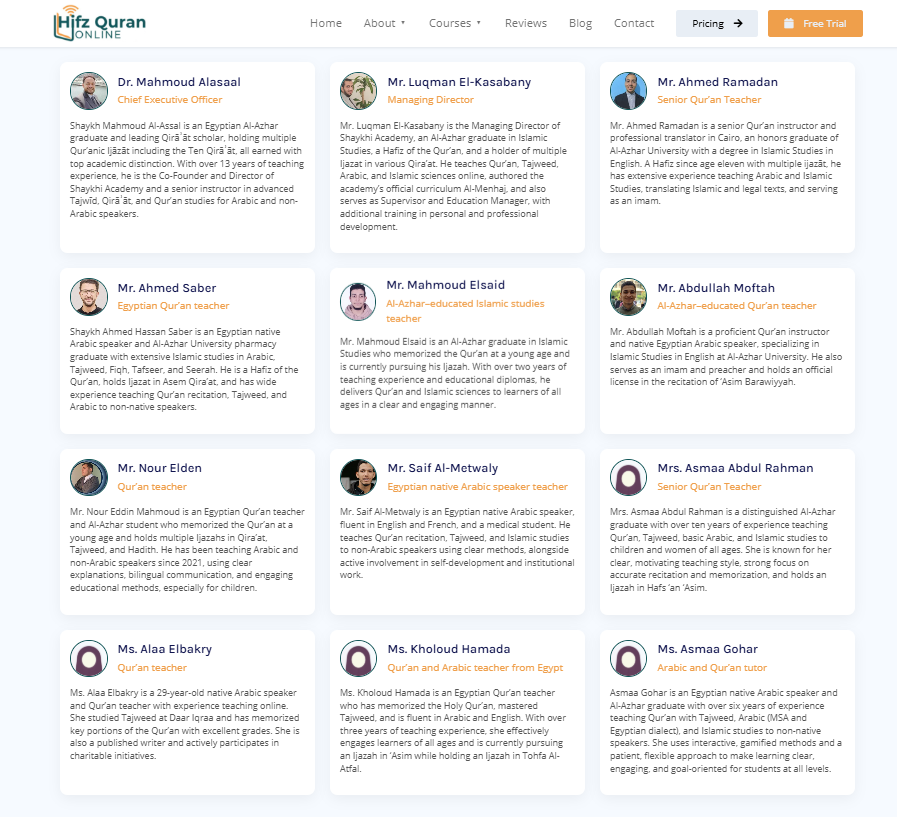
At Hifz Quran Online Academy, our certified Huffaz hold verified Sanad credentials, which means the certificates our completing students receive carry documented scholarly lineage — not simply an institutional stamp.
Book a FREE session with one of our Ijazah-certified teachers
What Does the Hifz Completion Certificate Process Actually Require?
Earning a hifz completion certificate requires more than finishing your memorization — it requires a formal oral examination process that is structured, rigorous, and conducted by a qualified examiner. This is where many students who memorized informally find themselves without a credentialed pathway.
The standard process involves three stages: internal review, oral examination, and issuance. During internal review, the student demonstrates their memorization to their regular instructor across multiple sessions.
The oral examination tests complete recall — typically Juz’ by Juz’ — with the examiner selecting random verses and requiring continuation without prompting. Only upon satisfactory completion of this examination is the certificate formally issued.
What Tajweed Standard Is Required for Hifz Certification?
Certification requires mastery of applied Tajweed — not theoretical knowledge alone. Examiners assess Makhraj (articulation point accuracy), Sifat al-Huruf (letter characteristics), correct Ghunnah duration, proper Waqf and Ibtida’ (stopping and starting points), and the rules of Madd (elongation). Surface-level recitation is not sufficient.
At Hifz Quran Online Academy, students preparing for certification examination undergo targeted Tajweed revision sessions in the final phase of their program. We have observed that students who integrate Tajweed correction from their very first lesson — rather than treating it as a finishing stage — consistently pass their certification examinations on the first attempt.
Memorize the Quran at Your Own Pace
Join our expert tutors and begin your Hifz journey with a personalized plan.
Start Your Free TrialIs an Online Hifz Program Certification Recognized and Legitimate?
Quran Hifz program certification from an online academy is recognized and legitimate when the issuing instructors hold verified Ijazah credentials and the program follows a structured, examination-based completion protocol. The medium of instruction — online or in-person — does not diminish certification validity; the instructor’s authority does.
Accredited online Hifz programs have become the primary pathway for non-Arabic speaking Muslims in Western countries to access certified instruction. Many mosques, Islamic centers, and academic institutions now explicitly accept certificates from verified online academies.
The critical question to ask any online program is not “do you give a certificate” but “does your certifying instructor hold an Ijazah, and can they provide their Sanad chain?”
For students ready to begin this certified pathway, Hifz Quran Online Academy’s Quran Memorization Program connects learners with instructors whose credentials are verified and whose certification carries genuine scholarly weight.
Book a free trial to start your Hifz path today

How Long Does It Take to Earn a Hifz Certificate Through an Online Program?
Timeline depends on daily consistency and individual pace — not the medium. For adult non-Arabic speakers, completing the full 604 pages of the Quran typically requires 3–5 years at one new page per day with proper daily Muraja’ah.
Students who maintain a disciplined Quran memorization schedule — dedicating 60–90 minutes daily to new memorization and revision — consistently reach completion within this range.
| Student Profile | Daily New Memorization | Estimated Completion Time |
| Child (ages 7–12) | 3–5 lines | 4–6 years |
| Teen (ages 13–17) | ½–1 page | 3–5 years |
| Adult with flexible schedule | 1 page | 3–4 years |
| Adult with limited time | ½ page | 5–7 years |
These are instructional estimates based on typical student progress patterns. Individual results vary based on retention, consistency, and revision quality.
Read also: The Best Times to Memorize the Quran
What Is a Hafiz Certificate and How Is It Different from a General Completion Award?
A Hafiz certificate — the credential formally designating someone as a Hafiz of the Quran — is specifically issued upon completion of full Quran memorization with verified oral examination. It is distinct from partial completion awards, Tajweed certificates, or Qira’ah study certificates, which recognize different milestones.
The Hafiz designation carries specific religious and social meaning in Islamic tradition. It affirms that the holder has preserved the Book of Allah in their chest with transmission-grade accuracy. Allah ﷻ says:
إِنَّا نَحْنُ نَزَّلْنَا الذِّكْرَ وَإِنَّا لَهُ لَحَافِظُونَ
Innā naḥnu nazzalnā l-dhikra wa-innā lahu laḥāfiẓūn
“Indeed, it is We who sent down the Quran and indeed, We will be its guardian.” (Al-Hijr 15:9)
The Hafiz certificate is the human institution’s formal acknowledgment of a student’s participation in that preservation — a deeply significant credential beyond its professional utility.
The Prophet ﷺ said regarding the people of the Quran:
“The one who is proficient in the recitation of the Quran will be with the honorable and obedient scribes (angels).” (Sahih Muslim, 798)
This hadith underscores that the Hafiz’s excellence is connected to the quality of their recitation — precisely what the certification examination tests.
Read also: How to Memorize 2 Pages of Quran a Day?
How Should You Prepare Your Memorization for the Certification Examination?
Preparing for your Hifz certification examination requires a structured final-phase revision approach distinct from your regular memorization routine.
The examination tests random access — the ability to begin recitation from any point in the Quran without sequential warm-up. This requires a specific Muraja’ah strategy.
The most effective preparation method involves rotating complete Juz’ revision across a 30-day cycle while also drilling weak points.
For each Juz’, recite it completely without assistance, note where prompting was needed, and target those verses in focused daily sessions. Our guide on how to revise memorized Quran outlines this rotation system in full detail.
The Revision Ratio Required for Examination Readiness
| Phase | New Memorization | Daily Muraja’ah | Focus |
| Active Hifz (early) | 1 page | 5 pages | Building new content |
| Final 5 Juz’ | ½ page | 8–10 pages | Consolidating all prior |
| Pre-examination (final 60 days) | None | Full rotation of all 30 Juz’ | Examination simulation |
Students at Hifz Quran Online Academy preparing for their certificate examination follow a 60-day pre-examination protocol. Before introducing this structured final phase, we observed that students who went into examination without it frequently struggled with random-access recitation — even when their sequential recall was strong.
The distinction between knowing your memorization linearly and having it accessible from any entry point is what examination preparation must resolve.
Adults pursuing certification can access this structured final phase through our Online Quran Memorization Courses for Adults, which include dedicated examination preparation support.
Enroll in our Quran Memorization Course for Adults with a free trial
Our Students Reviews
Memorize the Quran at Your Own Pace
Join our expert tutors and begin your Hifz journey with a personalized plan.
Start Your Free TrialHow Do Children Earn a Hafiz Certificate and What Makes Their Path Different?
The path to a Hifz certificate for children follows the same essential requirements — full memorization, Tajweed accuracy, oral examination — but the methodology differs substantially. Children aged 7–12 memorize through shorter, more frequent sessions rather than extended single sittings. Retention at this age is exceptional, but the examination process must account for the child’s comprehension stage and recitation development.
Children should not be rushed through memorization to accelerate certificate attainment. The best age to memorize the Quran is a question of readiness, not calendar age — and certification examinations for children assess their current Tajweed standard, not a comparison to adult precision benchmarks.
Our Quran Memorization and Hifz for Kids Classes are designed with child-appropriate examination preparation built into the curriculum, Alhamdulillah, ensuring young students reach their Hafiz certificate without the burnout that accelerated programs often cause.
Start your child’s Hifz today with a free lesson
Begin Your Certified Hifz Path with Expert Guidance at Hifz Quran Online Academy
A Quran memorization certificate is only as strong as the program that prepared you for it.
Hifz Quran Online Academy offers:
- Certified Huffaz with verified Ijazah and Sanad credentials
- Personalized 1-on-1 instruction at your individual pace
- Flexible scheduling across all global time zones
- Structured methodology built specifically for non-Arabic speakers
- Dedicated programs for adults, children, and ladies
- A free trial lesson — no commitment required
Begin your certified Hifz path today. Your certificate starts with your very first lesson.
Memorize the Quran at Your Own Pace
Join our expert tutors and begin your Hifz journey with a personalized plan.
Start Your Free TrialChoose the program that fits your needs:
- Quran Memorization Course (comprehensive Hifz for all ages)
- Quran Memorization and Hifz for Kids
- Online Quran Memorization Courses for Adults
- Quran Hifz for Ladies.
Book your free trial lesson today and begin your journey to Hifz with expert guidance every step of the way.
Frequently Asked Questions About Quran Memorization Certificate
Is a Quran Memorization Certificate from an Online Academy Valid?
Yes — an online Quran memorization certificate is valid when the issuing instructor holds a verified Ijazah with an authenticated Sanad chain. Legitimacy is determined by the examiner’s credentials, not the learning medium. Always confirm that your program’s instructors can provide their Ijazah documentation and scholarly transmission chain before enrolling.
What Is the Difference Between a Hifz Certificate and an Ijazah?
A Hifz certificate documents completion of full Quran memorization with Tajweed accuracy. An Ijazah is a specific scholarly authorization permitting the holder to transmit the Quran to others with that transmission counted in an authenticated chain. A student may receive a Hifz certificate without a personal Ijazah — but the examining instructor must hold one for the certificate to carry Sanad-based validity.
Can Adults Who Memorized Without Formal Instruction Obtain a Hifz Certificate?
Yes, but they must complete a formal oral examination before a qualified, Ijazah-holding instructor. The examination does not assess how you memorized — only whether your current recitation meets Tajweed and retention standards. Many adults who memorized informally pursue structured review through programs like those at Hifz Quran Online Academy before sitting for formal certification. Our article on how to become a Hafiz addresses this pathway in detail.
How Many Times Must I Recite the Full Quran Before Certification Examination?
There is no single universal standard — requirements vary by institution and instructor. Traditionally, a student is considered examination-ready when they can recite any Juz’ from random entry points without prompting, sustain recitation across consecutive sessions without degradation, and demonstrate consistent Tajweed accuracy throughout. Most qualified instructors require multiple full review cycles before scheduling a formal examination.
Does Completing a Hifz Certificate Allow Me to Lead Tarawih Prayer?
Completing a Hifz certificate demonstrates the memorization and Tajweed standard required to lead Tarawih. However, each mosque sets its own requirements for Imams leading Tarawih — some require a formal certificate, others require a personal recommendation from a credentialed scholar. In most Western Muslim communities, a certificate from a program with verified Ijazah-holding instructors is sufficient for Tarawih leadership consideration.
Related Articles
Memorizing Quran

Leave a Reply